

Hybrid personal training combines scheduled in-person coaching with app-based or live virtual support. It suits busy UK adults who want professional guidance without being tied to the gym every session. If you travel for work, have unpredictable hours, or simply want more value from your monthly training spend, this model is built for you.
Is it right for you? Three quick indicators:
- You can commit to at least one in-person session per week but your schedule makes two or three unrealistic.
- You are comfortable using a smartphone app to log workouts and message your trainer between sessions.
- You want coaching that covers more than just gym time, including nutrition, habits, and progress tracking.
If those three points sound familiar, read on. The pricing section will show you what to expect to pay in the UK, the checklist section will help you pick the right trainer, and the Yourcoachify section explains how to find vetted coaches quickly.
Table of Contents
- What hybrid personal training actually includes
- How a hybrid programme runs day to day
- Why many busy people prefer this model
- When hybrid training might not be the right fit
- What does hybrid personal training cost in the UK?
- How to choose a hybrid personal trainer: a practical checklist
- What your first month of hybrid training looks like
- Which tech tools support a good hybrid programme?
- How Yourcoachify helps you find a vetted hybrid trainer in the UK
- Key takeaways
- The case for hybrid training that most guides miss
- Ready to find your hybrid trainer on Yourcoachify?
- Useful sources and further reading
What hybrid personal training actually includes
Blended fitness coaching is not simply "some gym sessions plus a WhatsApp group." A well-designed hybrid programme has four distinct components working together.
Core components:
- Scheduled in-person sessions: technique coaching, movement assessment, and high-skill lifts that genuinely benefit from hands-on correction.
- Live virtual sessions: real-time coaching via video call for days when travel is impractical.
- App-delivered programming: structured workouts with video demonstrations, load guidance, and RPE cues for independent training days.
- Automated check-ins and habit tools: weekly forms, nutrition logging, and progress photos that keep your trainer informed without requiring a call every time.
Most coaches package these into tiers:
- Entry tier: app programming plus one in-person session per month and weekly check-in forms.
- Mid tier: one or two in-person sessions per week, one live virtual session, app programming, and nutrition guidance.
- Premium tier: two or more in-person sessions, multiple live virtual sessions, full nutrition coaching, habit tracking, and priority messaging.
The key difference from purely online personal training is the regular face-to-face element. The key difference from purely in-person training is that you are not paying for a trainer's time every single session, which changes both the cost and the flexibility considerably.

How a hybrid programme runs day to day
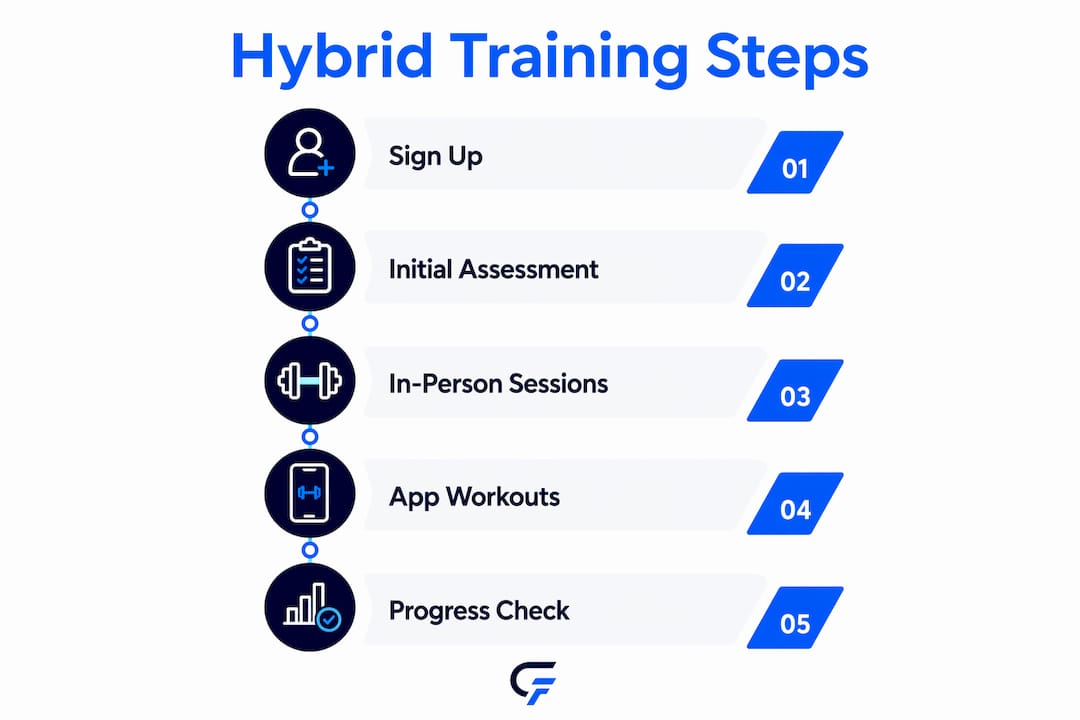
Understanding the weekly rhythm helps you decide whether this fits your life before you commit.
Typical onboarding process:
- Initial assessment: your trainer reviews your health history, movement patterns, and goals, usually in person or via a detailed intake form plus a video call.
- First in-person technique session: you learn the core movements your programme will be built around, so you can perform them safely without supervision.
- App setup: your trainer loads your first training block, sets up check-in forms, and walks you through how to log sessions and message them.
- Expectation setting: you agree on the session split, communication response times, and what "progress" looks like for your specific goals.
A realistic weekly rhythm might look like this:
- Monday: in-person session with your trainer.
- Wednesday: independent app session (video demos, logged in the app).
- Friday: second independent or live virtual session.
- Sunday: weekly check-in form (energy, sleep, adherence, any questions).
Communication between sessions typically flows through the coaching app: short messages, progress photos, and form check videos. Wearable integrations with devices like Garmin or Apple Watch can feed sleep and activity data directly to your trainer, giving them a fuller picture without extra effort from you.
Pro Tip: The single behaviour that separates clients who thrive in hybrid coaching from those who drift is completing the weekly check-in form, even when the week was poor. A trainer who sees a bad week can adjust. A trainer who hears nothing assumes everything is fine.
Successful hybrid programmes depend on frequent, proactive communication. Without structured check-ins, hybrid coaching commonly underperforms compared with in-person models.
Why many busy people prefer this model
The practical advantages of gym and virtual training go beyond simple convenience.
- Time saved: removing the commute from two or three sessions per week can free up several hours monthly. That time compounds over a twelve-week programme.
- Better value per month: because you are not paying for a trainer's physical presence every session, the monthly cost is typically lower than an equivalent volume of purely in-person coaching.
- Higher consistency: Les Mills data shows over 70% of virtual fitness users cite flexibility as their primary reason for choosing the format, and more than 75% who train virtually also attend live sessions, suggesting the two formats reinforce rather than replace each other.
- Broader coaching scope: a good hybrid package covers nutrition, habits, and recovery, not just the workout itself.
- Reduced self-consciousness: training at home or in a quieter setting removes the social friction some people feel in a busy gym, which can make it easier to stay consistent.
Statistic to note: Les Mills reports an increase in live attendance when virtual options are added alongside in-person classes, suggesting that flexible formats build the habit of training rather than replacing it.
The shift that matters most is this: effective hybrid coaching moves away from billing for time and towards delivering a results roadmap. You are buying a coaching relationship and a structured plan, not a block of hours.
When hybrid training might not be the right fit
Hybrid coaching is not the answer for every situation. Knowing the limitations helps you make a confident decision.
Situations where fully in-person coaching is the better choice:
- Complex clinical rehabilitation following surgery or serious injury, where hands-on assessment is a safety requirement.
- Advanced technical lifts (competition powerlifting, Olympic weightlifting) where subtle form errors require immediate physical correction.
- Complete beginners who have never trained before and need extensive hands-on guidance across every session before they can train independently.
Red flags to watch for in hybrid offers:
- No central coaching app: if your trainer plans to send programmes via email and check in via WhatsApp, the system will fragment and your adherence will likely suffer.
- Vague session splits: "a mix of in-person and online" with no defined frequency is not a hybrid programme, it is an ad hoc arrangement.
- Missing or unverifiable qualifications: no CIMSPA or REPs registration, no insurance confirmation, and no verified client reviews are all reasons to look elsewhere.
- No clear cancellation or refund policy: reputable coaches set this out before you pay.
What hybrid demands from you as a client:
Independent sessions only work if you complete them. Programme design must differ between supervised and unsupervised workouts, so a good trainer will build in video demos, explicit load guidance, and RPE cues. But you still need to show up for those sessions without a trainer physically present. If self-motivation for solo training is a genuine struggle, a higher ratio of in-person sessions may serve you better to start.
What does hybrid personal training cost in the UK?
Pricing varies by trainer experience, location, and package depth, but the structure is fairly consistent across the market.
Common pricing models:
- Monthly subscription tiers: a fixed monthly fee covering a set number of in-person sessions, app programming, and check-ins. Most common for ongoing coaching relationships.
- Credit packs: a bundle of in-person and virtual session credits used flexibly across the month.
- Per-session plus app fee: a lower per-session rate combined with a monthly platform or coaching fee.
Representative UK price bands (approximate ranges):
| Tier | Typical monthly cost | What's usually included |
|---|---|---|
| Entry | App programming, 1 in-person session/month, weekly check-ins | |
| Mid | Typically around £250/month | 2–4 in-person sessions/month, live virtual sessions, nutrition guidance |
| Premium | 6–8 in-person sessions/month, full nutrition coaching, priority support |
To understand the value, consider a straightforward comparison. A client paying £65 per in-person session for four weekly sessions spends roughly £260 per month for gym sessions alone, with no app programming, no nutrition support, and no check-ins between visits. A mid-tier hybrid package at £250 per month might include two in-person sessions, two app sessions, weekly check-ins, and basic nutrition guidance. Replacing some in-person hours with app-based sessions typically reduces total monthly cost while adding coaching depth.
Hybrid is generally more affordable than all in-person training at the same volume, because it reduces the number of high-cost face-to-face hours without reducing professional oversight.
How to choose a hybrid personal trainer: a practical checklist
A good discovery call takes fifteen minutes and tells you almost everything you need to know. Before you get there, run through this checklist.
Non-negotiable checks before booking:
- Qualifications: confirm CIMSPA membership or REPs Level 3 (or above) registration. These are the recognised UK standards for personal trainers.
- Insurance: public liability and professional indemnity insurance should be confirmed before any session.
- Verified reviews: look for reviews on a third-party platform or marketplace, not just testimonials the trainer has selected for their own website.
- Transformation galleries: before-and-after content with context (goal, timeframe, training approach) is more useful than a single photo.
- Clear pricing and cancellation policy: if pricing is not listed or requires a sales call to reveal, that is a yellow flag.
Questions to ask on a discovery call:
- What does your onboarding process look like, and how long before I have my first full programme?
- Which app or platform do you use, and does it handle programming, logging, messaging, and nutrition in one place?
- What is the typical split between in-person and independent sessions for a client with my goals?
- How do you measure progress, and how often do we review and adjust the plan?
- What happens if I need to cancel or pause my programme?
How to read a trainer profile:
Verified reviews that mention specific outcomes (strength gains, weight loss over a named timeframe, improved technique) carry more weight than generic praise. A transformation gallery with no context is less useful than one that names the goal and the duration.
Pro Tip: Book a single trial session or a paid discovery call before committing to a monthly package. A trainer who is confident in their coaching will offer this. It lets you test the platform, the communication style, and the session quality at low cost before you sign up for three months.
What your first month of hybrid training looks like
Knowing what to expect in weeks one to four helps you stay patient and consistent when early progress feels slow.
Week-by-week breakdown:
- Week 1: initial assessment, first in-person technique session, app setup, and logging your first independent workout. Focus is on learning the system, not pushing intensity.
- Week 2: first full week of the programme. Complete all scheduled sessions, fill in your check-in form honestly, and note any exercises that feel unclear or uncomfortable.
- Week 3: your trainer reviews your first two weeks of data and adjusts loads or technique cues. This is when the programme starts to feel genuinely personalised.
- Week 4: first progress checkpoint. Expect small but measurable improvements: better technique on key lifts, improved energy levels, and a clearer sense of what your training week looks like.
Realistic early progress markers:
- Consistency: completing 80% or more of scheduled sessions in month one is a strong indicator of long-term success.
- Technique: noticeable improvement in movement quality on two or three key exercises.
- Energy and recovery: most clients report improved sleep and energy within three to four weeks of consistent training.
Client actions that make month one count:
- Log every session in the app, even the imperfect ones.
- Submit your weekly check-in form before your trainer has to chase you.
- Ask questions about exercises you are unsure of before the next in-person session.
- Take progress photos at the start, even if you find it uncomfortable. They become your most motivating data point later.
Which tech tools support a good hybrid programme?
The technology behind a hybrid programme is not just admin. It is the infrastructure that keeps you accountable between sessions.
Categories of tech your trainer should use:
- Coaching apps (such as Trainerize or TrueCoach): deliver your programme, host video demonstrations, track your logs, and centralise messaging. A single centralised platform for all of this is non-negotiable for a well-run hybrid programme.
- Live video platforms: Zoom or Google Meet for virtual coaching sessions where your trainer watches your form in real time.
- Wearable integrations: Apple Watch, Garmin, or Fitbit data can feed into coaching apps to give your trainer visibility of your activity, sleep, and heart rate between sessions.
- Habit and nutrition trackers: apps like MyFitnessPal or Cronometer, often integrated into the coaching platform, allow your trainer to monitor nutrition without requiring a separate check-in.
What a good coaching app should do:
- Show video demonstrations for every exercise, not just a name and a rep count.
- Allow you to log sets, reps, and weights and add notes for your trainer.
- Send automated check-in forms at a set interval.
- Keep all messaging in one thread rather than splitting it across email and text.
| Tech category | What it solves | What to check |
|---|---|---|
| Coaching app | Programme delivery, logging, messaging | Is it one platform or fragmented across tools? |
| Live video | Real-time form coaching | Does the trainer use it for technique-heavy sessions? |
| Wearable integration | Activity and recovery data | Which devices does the app support? |
| Nutrition tracker | Diet monitoring between sessions | Is it built into the coaching app or a separate login? |
If a trainer's tech stack requires you to check three different apps and a spreadsheet, that fragmentation will erode your consistency. Gym-based promotion and in-person touchpoints can complement the digital layer, but the digital layer itself needs to be centralised.
How Yourcoachify helps you find a vetted hybrid trainer in the UK
Finding a hybrid trainer who ticks every box on the checklist above is straightforward on Yourcoachify. As the UK's coach marketplace, Yourcoachify connects you with personal trainers across the country, from gyms in London to parks in Manchester, with filters that let you search by specialty, location, and training format.
What Yourcoachify surfaces for every trainer profile:
- Verified qualifications (CIMSPA/REPs level confirmed).
- Verified client reviews from real bookings, not self-selected testimonials.
- Transformation galleries with context.
- Clear pricing and cancellation terms before you commit.
- Discovery call availability so you can speak to a trainer before booking.
Whether your goal is weight loss, strength training, nutrition coaching, or pre- and postnatal fitness, Yourcoachify's search filters match you to trainers who specialise in exactly that. You can browse hybrid personal trainers across the UK, compare profiles side by side, and book a discovery call or trial session directly through the platform.
Key takeaways
Hybrid personal training suits busy UK adults best when it combines a clear session split, a single coaching app, and a trainer with verified qualifications and a results-focused approach.
| Point | Details |
|---|---|
| Hybrid suits busy schedules | Combines in-person technique sessions with app-based independent training to reduce commute without reducing coaching quality. |
| Les Mills flexibility data | Over 70% of virtual users cite flexibility as their primary reason for choosing the format, and virtual uptake correlates with a 12% lift in live attendance. |
| UK pricing range | A typical mid-tier hybrid package costs around £250 per month, covering several in-person sessions, app programming, and nutrition guidance. |
| Centralised tech matters | A single coaching app for programming, logging, messaging, and check-ins is the strongest predictor of hybrid programme success. |
| Find vetted trainers on Yourcoachify | Yourcoachify lists UK hybrid trainers with verified reviews, qualifications, and clear pricing so you can book with confidence. |
The case for hybrid training that most guides miss
The conventional wisdom on hybrid personal training focuses almost entirely on flexibility, as though the main selling point is simply "you can skip the commute." That framing undersells what the model actually does well and oversells it in ways that set clients up for disappointment.
The real advantage of a well-run hybrid programme is not convenience. It is continuity. An in-person-only client who travels for work, gets ill, or has a chaotic week simply misses sessions. A hybrid client has a structure that bends without breaking. The programme continues, the check-in still happens, and the trainer still has data to work with. That continuity compounds over months in a way that sporadic in-person training rarely does.
What most guides also miss is the quality gap between hybrid programmes. A trainer who sends a PDF and calls it hybrid coaching is not the same as one who uses a proper coaching app, designs independent sessions with video cues and RPE guidance, and reviews your data before every check-in. The format is only as good as the coach running it. That is why checking qualifications, verified reviews, and the specific tech stack a trainer uses matters far more than the label "hybrid" on their profile.
For busy UK adults, the question is not really "in-person or hybrid?" It is "which hybrid coach has the structure, the credentials, and the communication style to keep me consistent for twelve weeks?" That is a much more useful question to answer before you book.
Ready to find your hybrid trainer on Yourcoachify?
Yourcoachify is the faster route to a vetted hybrid personal trainer in the UK, without the guesswork of searching gym noticeboards or social media profiles. Every coach on the platform has verified qualifications, real client reviews, and transparent pricing listed before you make any commitment.

Search by location, specialty, or training format, then book a discovery call or trial session directly through the platform. You can compare trainer profiles side by side, check transformation galleries, and confirm cancellation terms before you pay a penny. Whether you are in London, Manchester, or anywhere else in the UK, find your hybrid trainer on Yourcoachify and take the first step with confidence.
Useful sources and further reading
- NASM: Hybrid personal training — industry guidance on outcome-focused hybrid coaching and the shift from time-based to results-based billing.
- NFPT: Virtual personal training — practical guidance on programme design differences between supervised and independent sessions.
- Trainerize: Hybrid personal training — detailed breakdown of hybrid package tiers, communication requirements, and centralised platform use.
- Trainerize: How to price personal training — pricing models and comparative cost examples for hybrid versus in-person packages.
- Les Mills: Virtual workouts — data on virtual fitness uptake, flexibility as a driver, and the relationship between virtual and live attendance.
- Yourcoachify — the UK's coach marketplace for finding and booking vetted hybrid personal trainers with verified reviews, qualifications, and transformation galleries.
- Kingdom Signage: Promoting personal training — guidance on in-gym communication and coach-client touchpoints that complement digital hybrid delivery.
- Fortivus Pro — context on AI-assisted training tools and wearable integrations relevant to hybrid programme delivery.