

Use Yourcoachify to find a vetted nutrition coach in the UK today. It is the fastest way to search verified profiles, compare qualifications, and book a free discovery call without any guesswork. Here is how to get started right now:
- Filter by specialty: search "weight loss", "gut health", "sports nutrition", or "peri-menopause" to narrow results immediately.
- Check qualifications: look for AfN registration, an MSc in nutrition, or HCPC registration for clinical needs.
- Choose your format: toggle between online and face-to-face to match your lifestyle.
- Set a price band: filter by budget so you only see coaches within your range.
- Book a discovery call: most coaches offer a free initial call — use it to ask questions before committing.
Head to Yourcoachify, search "nutrition coach", and apply those filters to see who is available near you or online across the UK.
Table of Contents
- What does a nutrition coach do, and how is that different from a dietitian?
- What services and programmes do UK nutrition coaches offer?
- Who does nutrition coaching help, and where are the limits?
- What qualifications and trust signals should you check?
- How does nutrition coaching work, and what happens in your first session?
- What does nutrition coaching typically cost in the UK?
- Online coaching versus face-to-face: which suits you?
- How do you choose the right nutrition coach?
- Why use Yourcoachify to find a UK nutrition coach?
- How long does the hiring process take from first search to first session?
- What are the total costs, including hidden fees and package deals?
- Key takeaways
- What good nutrition coaching actually looks like
- Ready to find your nutrition coach on Yourcoachify?
- Useful sources and further reading
What does a nutrition coach do, and how is that different from a dietitian?
A nutrition coach supports you in building healthier habits, improving your relationship with food, and reaching goals like weight management or better energy. The work is behaviour-centred: coaches help you understand your patterns, set realistic targets, and stay accountable week by week. They are not clinically trained to diagnose or treat medical conditions.

A Registered Dietitian (RD) is a different role entirely. RDs are regulated by the Health and Care Professions Council (HCPC), hold clinical qualifications, and can diagnose and treat medical nutrition problems. They often work within NHS settings or specialist clinics. A nutrition coach, by contrast, works with otherwise healthy clients on habit change and general wellbeing.
When to choose which:
- Nutrition coach: weight management, habit change, sports performance, gut wellness, life-stage support (peri-menopause, postnatal), plant-based eating.
- Registered Dietitian: diagnosed conditions such as coeliac disease, type 2 diabetes, IBD, or clinical eating disorders.
- GP first: if you have undiagnosed symptoms or suspect a medical condition, speak to your GP before booking a coach.
What services and programmes do UK nutrition coaches offer?
Coaches structure their work in several ways, so you can usually find a format that fits your schedule and goals. Common programme types include:
- One-off consultation: a single session for focused advice on a specific question, such as pre-race fuelling or reading a blood test.
- 6-week programme: a structured block covering goal-setting, habit building, and a personalised eating plan with regular check-ins.
- 12-week programme: the most popular format for lasting change; tiered approaches from single sessions to 12-week plans are standard across UK coaches.
- Monthly ongoing coaching: a rolling subscription for continued accountability once an initial programme ends.
- Sports performance nutrition: tailored to energy, recovery, and training goals for athletes and active clients, grounded in fuelling rather than restriction.
- Gut-health package: focused on identifying food triggers, improving digestion, and building a sustainable eating pattern.
- Peri-menopause and hormonal support: specialist coaching that accounts for hormonal shifts and their effect on appetite, weight, and energy.
Many coaches also offer add-ons: bespoke meal plans, recipe packs, WhatsApp accountability between sessions, and in some cases DNA testing or functional lab work. These extras affect cost, so clarify what is included before you book.

Who does nutrition coaching help, and where are the limits?
Coaching suits a wide range of goals. You are likely a good fit if you want to:
- Lose weight or change your body composition without a restrictive diet.
- Improve sports performance and recovery through smarter fuelling.
- Manage gut symptoms such as bloating or irregular digestion.
- Navigate peri-menopause or postnatal nutrition changes.
- Shift to a plant-based or flexitarian diet confidently.
- Build consistent habits around food after years of yo-yo dieting.
Coaching frameworks frequently include behaviour-change methods and specialisms such as peri-menopause support and sports nutrition, which means the best coaches bring more than meal plans to the table.
One important boundary: if you have a diagnosed condition such as IBS, type 2 diabetes, or a history of disordered eating, speak to your GP and ask for a referral to a Registered Dietitian before or alongside any coaching. A coach can complement clinical care, but they cannot replace it.
What qualifications and trust signals should you check?
Credentials matter. The nutrition industry in the UK is not fully regulated, which means anyone can technically call themselves a "nutritionist" without formal training. Knowing what to look for protects you.
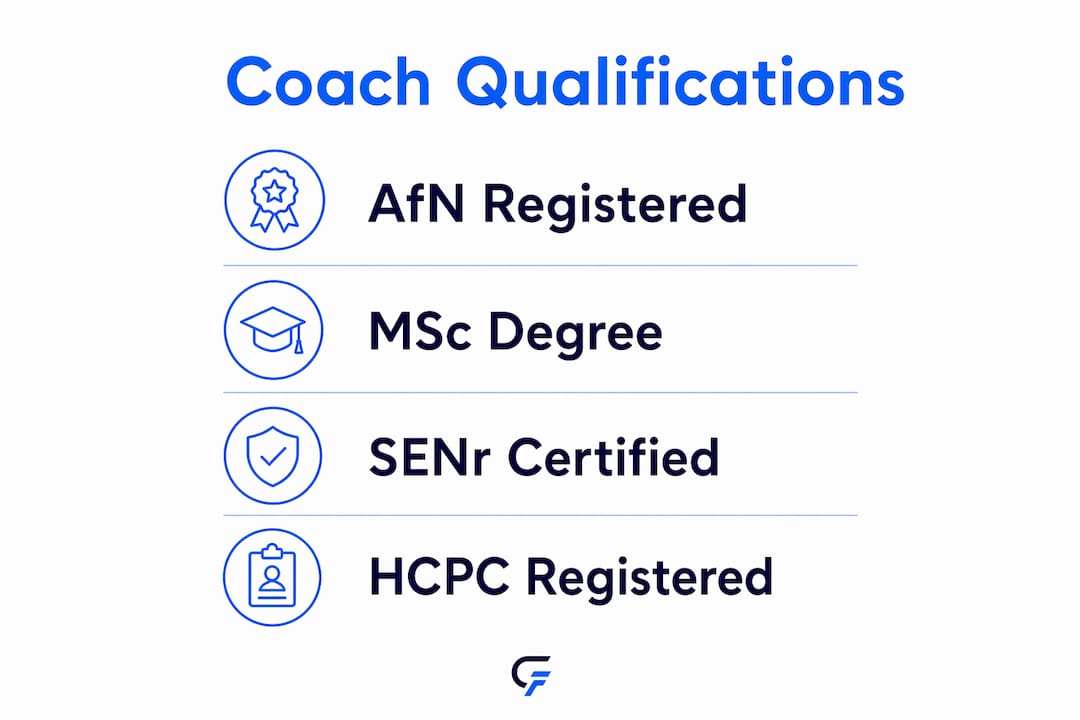
| Credential | What it means | Where to verify |
|---|---|---|
| AfN registration (Registered Nutritionist) | Postgraduate-level training, evidence-based practice | Association for Nutrition register |
| MSc in Nutrition or Dietetics | Academic specialist training | University transcript or LinkedIn |
| HCPC registration (Registered Dietitian) | Clinical qualification, legally protected title | HCPC online register |
| SENr registration | Specialist sports and exercise nutrition | SENr public register |
| CPD evidence | Ongoing professional development | Coach's profile or website |
Coaches often hold MSc degrees, SENr or AfN registration as evidence of specialist training. Always cross-reference a coach's claimed credentials against the relevant public register before booking.
On Yourcoachify, coach profiles display verified reviews, visible qualifications, and transformation galleries. Profiles that list qualifications, client testimonials and transformation galleries increase trust and make it easier to compare coaches side by side before you even pick up the phone.
How does nutrition coaching work, and what happens in your first session?
The process is more straightforward than most people expect. Here is what a typical journey looks like:
- Search and shortlist: use filters on Yourcoachify to find coaches who match your goal, preferred format, and budget.
- Book a discovery call: most coaches offer a free 15–20 minute call. Use it to ask about their methods, communication style, and what a programme includes.
- Initial assessment: your first paid session covers your health history, current eating patterns, lifestyle, and goals. Bring any recent blood tests, a rough food diary, and a list of current medications or supplements.
- Agreed plan: the coach builds a personalised strategy, which may include an eating framework, habit targets, and a check-in schedule.
- Ongoing support: weekly calls plus optional messaging support via WhatsApp or email keep you accountable between sessions. Some coaches use dedicated apps for food logging and progress tracking.
- Review and adjust: at regular intervals (usually every 4 weeks), the coach reviews your progress and adapts the plan.
Pro Tip: Prepare a three-day food diary before your first session. It gives your coach a realistic starting point and saves time on the initial assessment.
Sustainable results come from personalised strategies that match your values, lifestyle, and relationship with food. The first session is as much about the coach understanding you as it is about setting targets.
What does nutrition coaching typically cost in the UK?
Pricing varies considerably depending on the coach's experience, the programme length, and what is included. Common billing structures are:
- Per session: typically used for one-off consultations or pay-as-you-go arrangements.
- Multi-session packages: a fixed number of sessions sold together, usually at a slight discount versus paying individually.
- Monthly subscription: a rolling plan covering calls, messaging support, and resources for a set monthly fee.
- Tiered programmes: a 6 or 12-week block with a defined scope, often the most cost-effective route for lasting change.
The main cost drivers are the coach's qualifications and experience, session length and frequency, whether bespoke meal plans or lab testing are included, and how much ongoing messaging support is provided. A templated plan costs less than a fully bespoke programme built around your DNA results and blood work.
Before you commit, ask specifically about: cancellation and rescheduling policies, whether supplement recommendations carry any cost, and whether lab or DNA testing is charged separately. These are the most common sources of unexpected expense.
Online coaching versus face-to-face: which suits you?
| Online coaching | Face-to-face coaching | |
|---|---|---|
| Flexibility | High — sessions fit around your schedule | Lower — tied to location and availability |
| Access to specialists | Nationwide; location is no barrier | Limited to your local area |
| Accountability tools | Video calls, WhatsApp, apps | In-person check-ins, body composition testing |
| Hands-on assessment | Limited | Possible for body composition and clinical measures |
| Cost | Often lower (no travel overhead) | Can be higher in cities like London |
| Best for | Most goals; habit change, weight management, sports nutrition | Complex cases needing physical assessment |
Virtual-first services now include video consultations with ongoing support through WhatsApp, email, or coaching apps, making it possible to work with a specialist anywhere in the UK. London and Cambridge tend to have higher concentrations of coaches who offer optional in-person clinics alongside their online programmes, which suits clients who want the best of both.
In-person assessment is worth considering if your goals involve detailed body composition tracking or if you have a complex clinical picture that benefits from physical review.
How do you choose the right nutrition coach?
Start with a shortlist of three to five coaches who match your goal and preferred format. Then use these criteria to narrow it down:
- Qualifications: AfN, SENr, or HCPC registration relevant to your needs.
- Speciality match: a coach who works regularly with your specific goal (weight loss, sports, gut health) will have more refined tools for it.
- Communication style: the best client-coach matches are built on communication style and frequency — some clients need daily messaging, others prefer weekly check-ins.
- Pricing and scheduling: confirm session frequency, package length, and what happens if you need to reschedule.
- Client reviews: look for specific outcomes in testimonials, not just general praise.
Questions to ask on your discovery call:
- How do you measure progress beyond the scales?
- What does a typical week of support look like?
- How do you adapt the plan if I am not seeing results?
- What is your cancellation policy?
Red flags to watch for:
- Guaranteed rapid weight loss with no caveats.
- A single rigid meal plan with no flexibility or personalisation.
- Credentials that cannot be verified on a public register.
- Pressure to buy supplements or products through the coach.
Pro Tip: Ask the coach to describe a client who did not get the results they hoped for and what happened. A confident, honest answer tells you far more than a polished success story.
Why use Yourcoachify to find a UK nutrition coach?
Yourcoachify is built specifically to make finding and booking a vetted coach straightforward. Key features include:
- Searchable filters: narrow by specialty (weight loss, gut health, sports nutrition, peri-menopause), format (online or in-person), location, and price band.
- Verified reviews: every coach profile carries client reviews that have been verified, so you can read real feedback before committing.
- Visible qualifications: AfN registration, MSc credentials, SENr status, and other trust signals are listed directly on each profile.
- Transformation galleries: before-and-after context that shows the kind of results a coach's clients have achieved.
- Discovery call booking: book a free initial call directly through the platform without needing to exchange emails first.
Comparing multiple coaches side by side on one platform saves significant time. Rather than visiting five separate websites and waiting for email replies, you can shortlist, review, and book in a single session. For anyone searching for a personal nutrition coach across the UK, that reduction in friction makes a real difference.
How long does the hiring process take from first search to first session?
The timeline is shorter than most people expect:
- Day 1: search Yourcoachify, apply filters, and shortlist two or three coaches.
- Days 1–3: book discovery calls with your shortlisted coaches (many offer same-week availability).
- Days 3–7: complete discovery calls, compare approaches, and confirm your chosen coach.
- Days 7–14: complete any intake forms or pre-session questionnaires the coach sends.
- Week 2: attend your first paid session and receive your initial plan.
From first search to first session, most people are up and running within one to two weeks. The main variable is how quickly you book and complete discovery calls. Coaches with high demand may have a short waiting list, so it pays to move promptly once you have shortlisted.
What are the total costs, including hidden fees and package deals?
The full cost of a nutrition coaching programme depends on more than the headline session price. Here is what to account for:
- Programme fee: the core cost, whether per session or as a package. Longer programmes typically offer better value per session than pay-as-you-go.
- Meal plan or recipe pack add-ons: some coaches include these; others charge separately. Clarify upfront.
- Lab or DNA testing: functional testing (gut microbiome panels, food intolerance tests, DNA nutrition reports) can add a significant amount to the overall cost and is almost always charged separately.
- Supplement recommendations: a reputable coach will not pressure you to buy supplements, but some programmes include optional supplement guidance. If weight management support through clinical pathways is also relevant to your situation, that is a separate cost outside coaching.
- Cancellation fees: most coaches have a 24–48 hour cancellation window. Missing this can result in a charge for the session.
- Rescheduling limits: some packages cap the number of rescheduled sessions included in a programme.
The most cost-effective approach is usually a structured 6 or 12-week programme that bundles sessions, resources, and messaging support into one fee. Tiered coaching models with clearly defined inclusions make it easier to compare like for like and avoid surprise charges.
Key takeaways
Finding the right nutrition coach in the UK means checking credentials carefully, matching the programme type to your goal, and using a vetted marketplace like Yourcoachify to compare and book with confidence.
| Point | Details |
|---|---|
| Check credentials first | Look for AfN registration, an MSc, SENr, or HCPC status before booking any coach. |
| Match the programme to your goal | A 12-week programme suits lasting change; a one-off consult works for specific questions. |
| Use discovery calls | A free initial call lets you assess communication style and approach before committing. |
| Clarify all costs upfront | Ask about testing, meal plan add-ons, and cancellation policies to avoid hidden fees. |
| Start your search on Yourcoachify | Filter by specialty, format, and price to find a vetted UK nutrition coach quickly. |
What good nutrition coaching actually looks like
There is a version of nutrition coaching that gets talked about a lot: the structured meal plan, the macro targets, the weekly weigh-in. It sounds reassuring because it is measurable. The problem is that most people who follow a rigid plan for eight weeks and then stop have not actually changed anything about how they think about food.
The coaches worth working with spend as much time on the "why" behind your eating patterns as they do on the "what". Accountability tools such as messaging, food logs, and shared progress metrics are stronger predictors of long-term success than a single corrective meal plan. That is not a soft, feel-good claim. It reflects how behaviour change actually works: small, consistent adjustments that fit your real life outperform perfect plans that collapse under pressure.
When you are shortlisting coaches, pay attention to how they talk about progress. If the answer is purely about the scales or a calorie number, that is a narrow view. If they talk about energy, sleep, confidence around food, and how you feel in social eating situations, that is a coach who understands the full picture. Yourcoachify's verified profiles and client reviews make it easier to spot the difference before you spend a penny.
Ready to find your nutrition coach on Yourcoachify?
Yourcoachify gives you direct access to verified nutrition coaches across the UK, all in one place. Every profile shows real client reviews, visible qualifications, and clear service descriptions, so you know exactly who you are considering before you make contact. There are no long email chains or uncertainty about credentials.
Search Yourcoachify's nutrition coaches now, filter by your goal and preferred format, and book a free discovery call with a coach who fits. Most clients have their first session booked within a week.
Useful sources and further reading
- Association for Nutrition (AfN) — the UK's voluntary register for nutritionists; use it to verify whether a coach holds Registered Nutritionist status.
- Health and Care Professions Council (HCPC) — the statutory regulator for Registered Dietitians in the UK; check the public register to confirm clinical credentials.
- British Dietetic Association (BDA) — the professional body for dietitians; useful for understanding the difference between a dietitian and a nutritionist, and for finding NHS-referred dietetic support.
- NHS: Healthy eating — evidence-based government guidance on nutrition; a reliable baseline for understanding what healthy eating looks like before you start coaching.
- Yourcoachify — UK coach marketplace — search, compare, and book verified nutrition coaches across the UK using filters for specialty, format, and price.