

Yes, personal trainers in the UK can provide meal plans, and most qualified coaches are well-placed to help you build one. The boundary sits between nutrition guidance and medical nutrition therapy. A trainer can give you calorie targets, macro ranges, portion frameworks, and a practical 7-day menu aligned with the UK Eatwell Guide. What they cannot do is prescribe medical diets for disease states, diagnose eating disorders, or treat clinical conditions. For healthy adults with straightforward fitness, fat-loss, or performance goals, a personal trainer is a genuinely useful starting point.
Here is what to do next:
- Hire a qualified trainer who holds a nutrition coaching certificate alongside their PT qualification, and ask to see sample plan previews before booking.
- Request an initial nutrition consultation where the trainer assesses your habits, training load, and goals before drafting anything.
- Seek a registered dietitian if you have a diagnosed condition such as type 2 diabetes, a history of disordered eating, or complex metabolic needs.
Table of Contents
- What can personal trainers in the UK actually provide?
- What types of meal plans do personal trainers offer?
- What does a trainer-built meal plan usually include?
- How does a trainer build your personalised plan?
- How do you choose a personal trainer for nutrition coaching?
- What does nutrition coaching from a trainer typically cost in the UK?
- When should you see a registered dietitian instead?
- How Yourcoachify helps you find the right trainer for nutrition coaching
- Key takeaways
- Ready to find a trainer who can build your plan?
What can personal trainers in the UK actually provide?
NASM guidance is clear: trainers may offer evidence-based nutrition advice for healthy adults but must not prescribe medical meal plans or treat disease. In practice, that means a trainer can help you structure your eating, hit a calorie target, and build sustainable habits. They cannot act as a dietitian.
What sits within a trainer's scope:
- Setting daily calorie and protein targets based on your training load and goals
- Providing macro ranges (protein, carbohydrate, fat) as guidance, not prescription
- Offering portion-role templates (e.g. half the plate vegetables, a palm of protein)
- Building 7-day recipe-based menus for healthy adults
- Coaching shopping habits, meal-prep workflows, and behaviour change
- Providing grocery lists and PDF plan exports
What falls outside their scope:
- Prescribing therapeutic diets for diabetes, kidney disease, or other clinical conditions
- Diagnosing or treating eating disorders
- Providing medical nutrition therapy in any form
- Making clinical supplement recommendations beyond general guidance
The NSCA recommends that trainers maintain a network of registered nutrition professionals and use release-of-information forms when collaborating with dietitians. Similarly, NFPT guidance lists prohibited practices explicitly, including prescribing extreme regimes and providing nutritional therapy for disease.
Pro Tip: Ask your trainer upfront whether they have a registered dietitian they refer to when client needs to go beyond their scope. A trainer who can name a specific referral contact is one who takes professional boundaries seriously.
What types of meal plans do personal trainers offer?
Not all plans look the same, and the format that suits you depends on your lifestyle, cooking confidence, and how closely you want to track your intake.
- Calorie and macro-target plans give you daily numbers to hit (e.g. 2,100 kcal, 160 g protein) without specifying exact meals. These suit clients who prefer flexibility and already know their way around a kitchen.
- Recipe-based 7-day plans lay out every meal for the week with recipes, prep times, and a grocery list. They work well for clients who want clear structure and minimal decision-making.
- Portion-role templates use visual guides rather than numbers: a palm of protein, a fist of carbs, a thumb of fat. These are popular with clients who find calorie counting stressful.
- Flexible weekly systems combine a repeatable meal structure with interchangeable components. A batch-prep approach where slow-cook proteins, grains, and sauces are prepared in advance keeps the plan sustainable across a busy week.
- Performance-focused protocols are used with athletes or clients training at high volume. These factor in periodisation, carbohydrate timing around sessions, and recovery nutrition.
Busy clients with limited cooking time tend to do best with flexible weekly systems or portion templates. Clients focused on fat loss often prefer the accountability of a tracked macro plan. Athletes generally need a performance protocol that shifts with their training block.
What does a trainer-built meal plan usually include?
The deliverables vary by service tier, but a well-structured plan covers more than just a list of meals.
Common deliverables:
- A 7-day menu with breakfast, lunch, dinner, and snacks
- Daily calorie and macro totals per meal
- A consolidated grocery list, often grouped by store section
- Recipes with prep times and simple instructions
- A batch-prep workflow for the week
- A PDF export or app link for easy access
- One or two rounds of edits after the client reviews the draft
Service levels differ considerably. Some trainers offer a one-off plan as a standalone product. Others bundle nutrition coaching into a short package of four to eight weeks, with weekly check-ins and plan updates. Long-term coaching relationships include ongoing plan adjustments as your training load, goals, or preferences change.
| Tier | Typical deliverables | Support level |
|---|---|---|
| Basic template | Generic 7-day menu, grocery list, PDF | One-off, no edits |
| Tailored weekly plan | Bespoke menu, macros, grocery list, one edit round | Short package, occasional check-in |
| Ongoing nutrition coaching | Fully bespoke plan, weekly updates, macro tracking, habit coaching | Continuous, regular reviews |
Many trainers now use dedicated software to generate branded, client-specific PDF plans. Tools such as NutriAdmin allow coaches to produce professional plan documents quickly, which means you receive a polished, easy-to-follow file rather than a rough spreadsheet.
How does a trainer build your personalised plan?
Good trainers treat nutrition coaching as behaviour change work: they identify your friction points first, then build a plan that slots into your actual life rather than an idealised version of it.
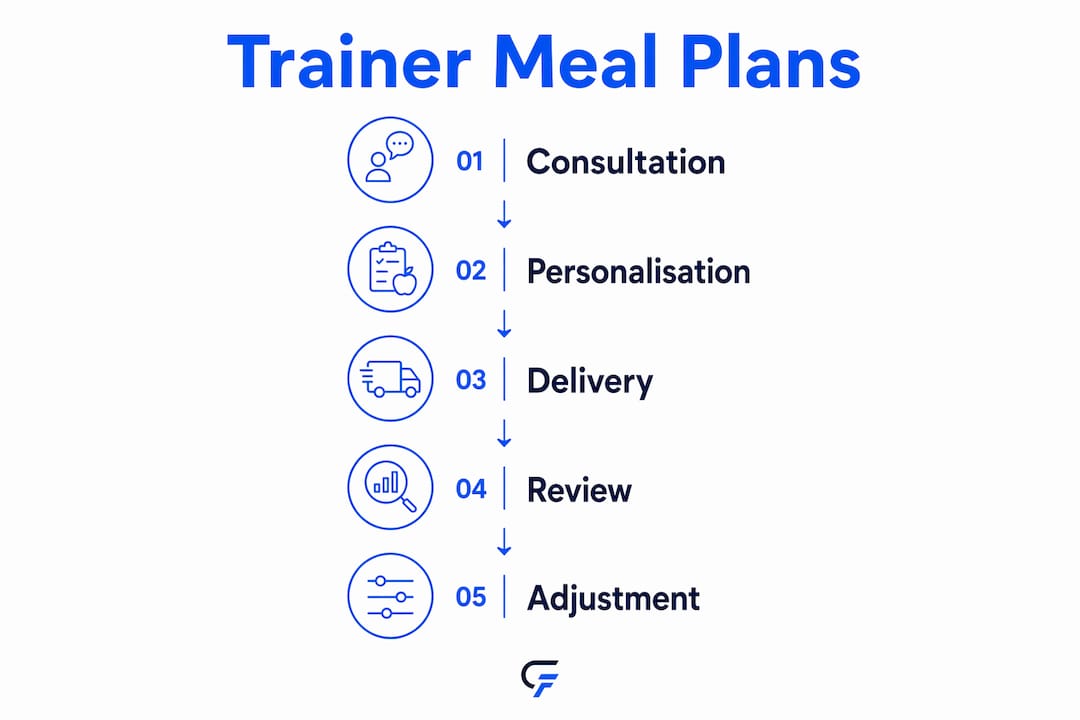
The typical process, step by step:
- Initial consultation — the trainer gathers your health history, current eating habits, and goals.
- Diet history and preferences — you discuss food likes, dislikes, allergies, intolerances, and cultural preferences.
- Activity and training load assessment — your weekly session volume, intensity, and non-exercise activity are factored into your daily calorie estimate.
- Goal setting — fat loss, muscle gain, performance, or habit change goals are clarified and prioritised.
- Calorie and protein estimation — the trainer calculates a starting target using your stats and activity level, with protein needs for training a key variable.
- Draft plan creation — the trainer builds the first version of your plan, often using software to speed the process.
- Client review and iteration — you review the draft, flag anything impractical, and the trainer refines it.
Questions your trainer will typically ask:
- How much time do you have to cook on weekdays versus weekends?
- Do you cook for a family or just yourself?
- Do you have any allergies or intolerances?
- How confident are you in the kitchen?
- What does a typical day of eating currently look like?
- Are there any foods you genuinely dislike or cannot eat?
From consultation to first plan delivery usually takes three to seven days. A first review typically happens one to two weeks after you start following the plan, once you have had a chance to test it in real life. Simpler, repeatable meal structures with batch-prep elements tend to produce better long-term adherence than complex plans that demand daily cooking from scratch.

How do you choose a personal trainer for nutrition coaching?
The right trainer has both the technical knowledge and the communication skills to make a plan you will actually follow.
Qualifications and credentials to look for:
- An accredited Level 3 or Level 4 Personal Training qualification (e.g. CIMSPA-endorsed)
- A nutrition coaching certificate from a recognised body (e.g. Precision Nutrition, NASM, NSCA)
- Evidence of continuing professional development (CPD) in nutrition
- Membership of a professional body such as CIMSPA or REPS
Questions to ask at first contact:
- What nutrition qualifications do you hold, and are they accredited?
- Can you show me a sample plan or describe what a typical client plan includes?
- How do you handle conditions that fall outside your scope, and do you have a dietitian referral?
- How many edit rounds are included, and how often will we review the plan?
- How do you track my progress and adjust the plan over time?
- What is your policy on client confidentiality and data storage?
Red flags to watch for:
- Promises of extreme or rapid weight loss without caveats
- Willingness to prescribe diets for medical conditions without referral
- No mention of a referral network or professional boundaries
- Vague or absent reviews and credentials on their profile
- Plans delivered with no initial consultation or assessment
On Yourcoachify, each coach profile includes verified reviews, listed qualifications, and transformation galleries. You can filter by specialism, including nutrition coaching, and see exactly what previous clients say before you book. That transparency makes it straightforward to compare coaches and ask the right questions with confidence.

What does nutrition coaching from a trainer typically cost in the UK?
Pricing varies depending on the trainer's experience, the depth of the plan, and whether nutrition is bundled with personal training sessions.
- One-off bespoke plan: typically £50–£150, depending on the level of tailoring and whether a consultation is included.
- Short nutrition coaching package (4–8 weeks): typically £100–£300, including plan creation, weekly check-ins, and revisions.
- Ongoing nutrition coaching bundled with PT sessions: often included as part of a monthly training package, which can range from £200 upwards depending on session frequency and location.
Factors that push the price up include the trainer's level of qualification, the complexity of your goals, and whether the plan is fully bespoke or adapted from a template.
For timelines, realistic expectations matter. Measurable changes in body composition generally take four to eight weeks of consistent adherence. Performance improvements, such as better energy during training, can appear within two to three weeks. Habit change, the most durable outcome, builds gradually and is usually noticeable after six to twelve weeks. Revision policies vary by trainer: some include two rounds of edits in the initial fee, others charge separately. Always confirm this before you commit.
When should you see a registered dietitian instead?
A personal trainer's nutrition guidance is appropriate for healthy adults with general fitness goals. There are situations where a registered dietitian or clinician is the right professional.
Refer to a registered dietitian if you have:
- A diagnosed condition such as type 1 or type 2 diabetes, kidney disease, or cardiovascular disease requiring dietary management
- A history of, or suspected, eating disorder (anorexia, bulimia, binge eating disorder, ARFID)
- Clinical malabsorption conditions such as coeliac disease or Crohn's disease
- A pregnancy with complications or a high-risk classification
- Unexplained significant weight loss or gain requiring medical investigation
- A complex medication regime where diet-drug interactions are a concern
When a referral is needed, a good trainer will document the reason, share relevant background information with the client's written consent, and signpost to resources such as the British Dietetic Association's Find a Dietitian directory. Maintaining that referral network is not a limitation on what a trainer offers. It is a mark of professionalism and a genuine protection for your safety.
How Yourcoachify helps you find the right trainer for nutrition coaching
Yourcoachify is a UK-wide coach marketplace where you can search for personal trainers by location, specialism, and availability. Every coach profile on the platform includes verified client reviews, listed qualifications, and transformation galleries, so you can assess a trainer's credibility before you make contact.
How to use Yourcoachify to find a nutrition-focused trainer:
- Use the specialism filter to search for trainers who list nutrition coaching as a service
- Read verified reviews from previous clients, paying attention to comments about plan quality and communication
- Check listed qualifications for nutrition-specific certificates alongside the PT qualification
- Book an initial consultation directly through the platform to discuss your goals and ask the questions from the checklist above
- Request a sample plan or outline of what the nutrition coaching package includes before committing
Yourcoachify supports both in-person and online coaching, so you can find a trainer who fits your schedule whether you train in a London gym or prefer remote coaching from anywhere in the UK.
Pro Tip: When you filter by "nutrition coaching" on Yourcoachify, look for trainers who mention specific plan formats (macro plans, 7-day menus, flexible weekly systems) in their profile. That specificity signals practical experience, not just a certificate.
Key takeaways
Personal trainers in the UK can legally provide nutrition guidance for healthy adults, but medical nutrition therapy for clinical conditions requires a registered dietitian.
| Point | Details |
|---|---|
| Scope of practice | Trainers may offer macro guidance, portion templates, and 7-day menus for healthy adults; they cannot prescribe medical diets. |
| When to refer | Conditions such as diabetes, eating disorders, or clinical malabsorption require a registered dietitian, not a trainer. |
| What to expect | A good plan includes a 7-day menu, calorie and macro totals, a grocery list, recipes, and at least one round of edits. |
| How to choose | Look for accredited PT and nutrition qualifications, verified reviews, a referral network, and a clear consultation process. |
| Find a trainer | Yourcoachify lists UK coaches with verified reviews and nutrition specialism filters, making it straightforward to book with confidence. |
A balanced view on nutrition coaching
The most common mistake people make when hiring a trainer for nutrition coaching is expecting a perfect plan on day one. The research is consistent: overly complex plans get abandoned. What actually works is a flexible structure that fits your existing routine, with enough room to adapt when life gets in the way.
There is also a tendency to underestimate the value of the referral boundary. A trainer who knows when to refer you to a registered dietitian is not admitting a limitation. They are demonstrating exactly the kind of professional judgement that keeps you safe and makes the coaching relationship more trustworthy, not less.
The UK fitness industry has matured considerably in this area. Accredited nutrition coaching certificates are now widely held, and platforms like Yourcoachify make it easier than ever to verify a trainer's credentials before you commit. The combination of a qualified trainer for day-to-day nutrition structure and a registered dietitian for clinical needs is not a compromise. It is simply good practice.
Useful sources and further reading
These are the primary sources used in this article. Each is worth bookmarking if you want to go deeper on scope, practice guidance, or tools.
- NASM: Offering Nutrition Advice — The Dos and Don'ts — the clearest summary of what trainers may and may not do; essential reading for both clients and coaches on legal scope.
- NSCA: Personal Trainers and Nutrition Advice — covers referral best practice and the use of release-of-information forms for dietitian collaboration.
- NFPT: The Role of Nutrition Coaching in Personal Training — lists prohibited practices explicitly; useful for understanding where the ethical line sits.
- Trainerize: How to Create a Meal Plan for Your Clients — practical guidance on the behaviour-change approach to meal planning and identifying client friction points.
- PlanEat AI: Personal Trainer Meal Plan Guide — covers 7-day plan structures, batch-prep workflows, and the flexible weekly system approach.
- NutriAdmin: Software for Personal Trainers — explains how dedicated software speeds plan creation and improves the professional quality of client deliverables.
- EvoFit Meals: AI-Powered Meal Planning for Fitness Professionals — demonstrates how automation tools are changing the way trainers scale nutrition services.
Ready to find a trainer who can build your plan?
Yourcoachify is the UK's coach marketplace built specifically for this. Rather than searching through social media profiles or relying on gym notice boards, you get a single platform where every trainer has verified reviews, listed qualifications, and a clear specialism profile. If nutrition coaching is what you need, the specialism filter surfaces coaches who offer exactly that, whether you want a one-off bespoke plan or ongoing support as part of a training package.
The process is straightforward: search by location or online preference, read verified client reviews, check qualifications, and book an initial consultation directly through the platform. From there, your trainer takes you through the assessment process, builds your plan, and supports you through the first weeks of following it.
If you are ready to get a personalised nutrition plan built around your goals, find your trainer on Yourcoachify today.
This article provides general information about nutrition coaching and personal trainer scope of practice. It is not a substitute for professional medical or dietary advice. If you have a health condition, please consult a qualified clinician or registered dietitian before making changes to your diet.