

The Level 3 Personal Training Diploma is the core qualification recognised by UK fitness employers, regulated by Ofqual, and endorsed by the Chartered Institute for the Management of Sport and Physical Activity (CIMSPA). Without it, you cannot legally call yourself a personal trainer in most professional settings across the UK. Understanding what these credentials involve helps you choose a trainer you can genuinely trust with your health and fitness goals.
Personal trainer qualifications in the UK follow a structured pathway. The Level 2 Gym Instructor Award forms the foundation, followed by the Level 3 Diploma as the professional standard. Both sit on the Regulated Qualifications Framework (RQF), which places them at a level equivalent to A-levels in terms of national recognition. CIMSPA endorsement adds a further layer of quality assurance, confirming that a course covers not just anatomy and programming, but also behavioural coaching and business skills.
What are the core personal trainer qualifications in the UK?
The Level 2 Gym Instructor qualification is the starting point for anyone entering the fitness profession. It covers gym floor safety, basic exercise instruction, and client communication. Most providers require candidates to be at least 16 years old, with no mandatory prior academic qualifications, though GCSEs in English and maths at grades A–C are helpful.
The Level 3 Personal Training Diploma builds directly on that foundation. It introduces anatomy and physiology in greater depth, nutrition principles, programme design, and one-to-one client coaching. These are the skills that separate a gym instructor from a qualified personal trainer. Integrated programmes covering both Level 2 and Level 3 in a single structured course better prepare trainers than studying each module separately, as they develop judgement and professional confidence progressively.

Typical course durations vary. Integrated programmes allow completion in as little as 4 months, with most routes averaging 6–9 months. That timeline suits people who want to enter the profession without a multi-year commitment.
Key subject areas covered in a Level 3 Diploma include:
- Anatomy, physiology, and kinesiology
- Nutrition and weight management principles
- Client assessment and goal setting
- Programme design for different fitness levels
- Motivational and behavioural coaching techniques
- Business skills: marketing, sales, and client retention
Pro Tip: If you are comparing personal trainer courses, look for providers that offer practical assessment components alongside written exams. Trainers who are assessed on real client interactions are better prepared for the demands of the job.
How do regulation and accreditation affect trainer credibility?
Ofqual is the government body that regulates qualifications in England. A qualification on the Regulated Qualifications Framework carries national recognition and a defined level of academic equivalence. Qualifications on the RQF have national recognition equating to A-level standards. That matters because it means a trainer's diploma is not just a certificate from a private provider. It is a nationally standardised credential.
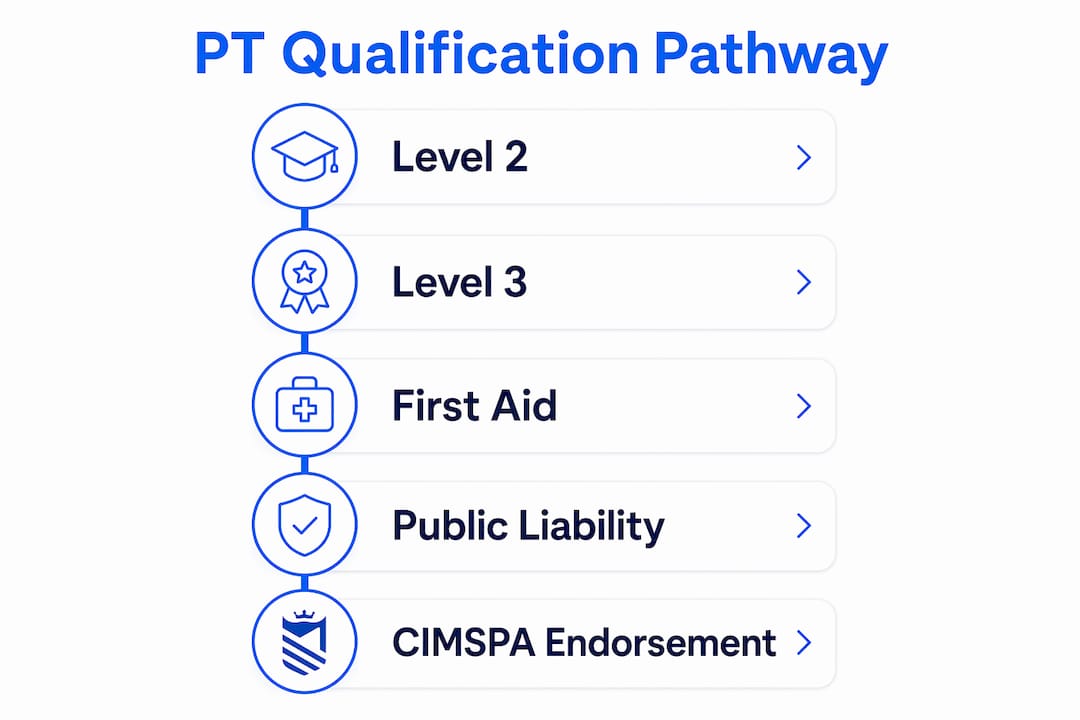
CIMSPA endorsement goes a step further. CIMSPA maps personal training courses to professional standards, verifying that a course covers behavioural coaching and business skills alongside technical knowledge. Employers across the UK prioritise trainers who hold CIMSPA-endorsed qualifications because it signals readiness for real-world client interaction, not just textbook knowledge.
When you are looking for a qualified trainer, these are the checks worth making:
- Confirm the trainer's diploma is Ofqual-regulated and sits on the RQF
- Check whether their course provider holds CIMSPA endorsement
- Ask to see their certificate and verify the awarding body is legitimate
- Verify the training centre is an approved provider, not just a self-accredited organisation
A trainer who cannot show you an Ofqual-regulated qualification has not met the national standard. That is a straightforward filter that protects you as a client.
What additional requirements make a trainer fully work-ready?
A diploma alone does not make a trainer ready to work. Trainers must hold valid first aid certification and public liability insurance to work legally in most UK gyms and leisure centres. Missing either of these can delay employment onboarding even after a diploma is completed. That is a practical detail many clients overlook when assessing a trainer's credentials.
First aid certification typically requires a one or two-day course and renewal every three years. Public liability insurance protects both the trainer and the client if an injury occurs during a session. Reputable trainers carry both without exception.
Beyond paperwork, the skills that separate good trainers from great ones are often interpersonal. Understanding client motivation, setting realistic expectations, and adapting communication styles to different personalities are not formally assessed in most diplomas. Effective personal trainers combine anatomical and programming knowledge with business skills like sales, marketing, and client management to build a sustainable career.
Practical experience during training also matters significantly:
- Work placements and shadowing opportunities build real-world confidence
- Apprenticeships or gym shadowing during qualification improve assessment success rates
- Observing experienced trainers reveals client management techniques that no textbook covers
- Volunteering to assist group fitness sessions builds communication skills quickly
Pro Tip: Ask any trainer you are considering working with how many hours of supervised client coaching they completed during their qualification. A higher number signals a more practice-focused training experience.
How to choose the right personal trainer course in the UK
Choosing a personal trainer course requires more than comparing prices. The quality of the provider, the structure of the course, and the support available all affect whether a trainer emerges genuinely ready to work with clients.
Course costs vary widely, ranging from several hundred pounds to over £1,000 depending on the provider, delivery method, and level of support included. Funding options include local colleges, Skills Bootcamps, and apprenticeship frameworks, depending on region and eligibility. Cost alone should not drive the decision. A cheaper course from an unaccredited provider can leave a trainer unable to secure employment.
The delivery format is another practical consideration. Online, in-person, and blended learning options each suit different learners. Online courses offer flexibility but require strong self-discipline. In-person courses provide direct tutor feedback and practical assessment opportunities. Blended programmes combine both, which suits many working adults.
When evaluating a course or provider, look for:
- Ofqual regulation and RQF placement confirmed on the provider's website
- CIMSPA endorsement clearly stated for the specific course
- Practical assessment components, not just written exams
- Named tutor support and a clear feedback process
- Transparent information on assessment methods and resit policies
- Evidence of graduate employment outcomes or industry partnerships
The mode of learning matters less than the quality of the qualification at the end. A blended course from a CIMSPA-endorsed, Ofqual-regulated provider is a stronger credential than an in-person course from an unaccredited organisation.
What career paths open after gaining a personal training qualification?
The Level 3 Diploma prepares graduates for a broad range of employment options, including gyms, private studios, self-employment, and corporate wellness programmes. That breadth is one of the qualification's genuine strengths. You are not locked into one type of role.
Typical career routes after qualifying include:
- Employed gym instructor or junior trainer. Many graduates start on the gym floor, building a client base within an established facility. This provides structure, footfall, and mentorship from senior staff.
- Self-employed personal trainer. Working independently in parks, private studios, or clients' homes offers greater flexibility and earning potential. It also requires stronger business and marketing skills.
- Online coaching. Remote coaching has grown significantly as a complement to in-person training. Qualified trainers can serve clients nationally without geographic limits.
- Corporate wellness. Companies increasingly hire trainers to deliver workplace fitness programmes. This route suits trainers who prefer group settings and regular hours.
- Specialist further qualifications. Trainers can progress into areas such as sports conditioning, pre and postnatal fitness, nutrition coaching, or rehabilitation. Each specialisation typically requires an additional Level 3 or Level 4 qualification.
Income varies considerably based on location, client base, and business skills. London-based self-employed trainers typically charge more per session than those in smaller cities, but operating costs are also higher. Building a sustainable income takes time regardless of location.
Key takeaways
The Level 3 Personal Training Diploma, regulated by Ofqual and endorsed by CIMSPA, is the definitive qualification standard for personal trainers working in the UK.
| Point | Details |
|---|---|
| Core qualification | The Level 3 Personal Training Diploma is the recognised professional standard for UK personal trainers. |
| Regulatory benchmark | Ofqual-regulated qualifications on the RQF carry national recognition equivalent to A-level standards. |
| CIMSPA endorsement | CIMSPA-endorsed courses verify that trainers have business, behavioural, and technical skills, not just theory. |
| Work-ready requirements | Valid first aid certification and public liability insurance are required alongside the diploma for gym employment. |
| Course selection | Choose an Ofqual-regulated, CIMSPA-endorsed provider with practical assessment components and clear tutor support. |
What I have learned about qualifications and what they actually mean
Qualifications are a foundation, not a finish line. I have seen trainers with impressive diplomas struggle to retain clients because they never developed the interpersonal skills that keep people coming back. A Level 3 Diploma tells you a trainer has met a national standard. It does not tell you whether they listen well, adapt their approach, or genuinely care about your progress.
The CIMSPA endorsement is the closest thing the industry has to a quality filter beyond the basic diploma. Courses that carry it have been mapped against professional standards that include behavioural coaching and business readiness. That matters because the trainers who build lasting careers are the ones who understand people, not just programming.
My honest view is that the qualification pathway in the UK is well-structured. The Level 2 to Level 3 route is logical, the regulatory framework through Ofqual is credible, and CIMSPA's role in setting professional standards is genuinely useful. What the system cannot guarantee is character, commitment, or the ability to build trust with a client over months and years. Those qualities come from experience, reflection, and a genuine interest in other people's wellbeing.
When you are looking for a trainer, treat the qualification as your minimum threshold. Then look beyond it. Ask about their practical experience, their approach to client communication, and how they handle setbacks. The best trainers are the ones who are still learning, regardless of how many certificates they hold. You can find verified, qualified trainers through Yourcoachify, where profiles include credentials, reviews, and real client outcomes.
— The
Yourcoachify: find a qualified personal trainer near you
Finding a trainer who holds the right credentials should not require hours of research.

Yourcoachify is the UK's coach marketplace, connecting you with personal trainers who hold verified qualifications, including Ofqual-regulated diplomas and CIMSPA-endorsed credentials. Each trainer profile on Yourcoachify includes their qualifications, specialisms, client reviews, and location, whether you are looking for a trainer in a London gym or a park in Manchester. You can filter by fitness goal, from weight loss to strength training, and read verified reviews before making any commitment. It is a straightforward way to find a qualified professional who meets national standards and fits your goals.
FAQ
What qualification does a personal trainer need in the UK?
A personal trainer in the UK needs a minimum of a Level 3 Personal Training Diploma, which must be Ofqual-regulated and ideally CIMSPA-endorsed to be accepted by major employers.
How long does it take to qualify as a personal trainer in the UK?
Integrated Level 2 and Level 3 programmes can be completed in as little as 4 months, with most routes averaging 6–9 months depending on the provider and study format.
Do personal trainers in the UK need insurance?
Yes. Most UK gyms require personal trainers to hold valid public liability insurance and a current first aid certificate before they can work with clients on-site.
What is CIMSPA and why does it matter?
CIMSPA is the Chartered Institute for the Management of Sport and Physical Activity. Its endorsement confirms that a personal training course meets professional standards for both technical and behavioural coaching skills.
Can I study for a personal trainer qualification online in the UK?
Yes. Many Ofqual-regulated providers offer online and blended learning options. The key is confirming the course carries CIMSPA endorsement and includes practical assessment components alongside online study.