
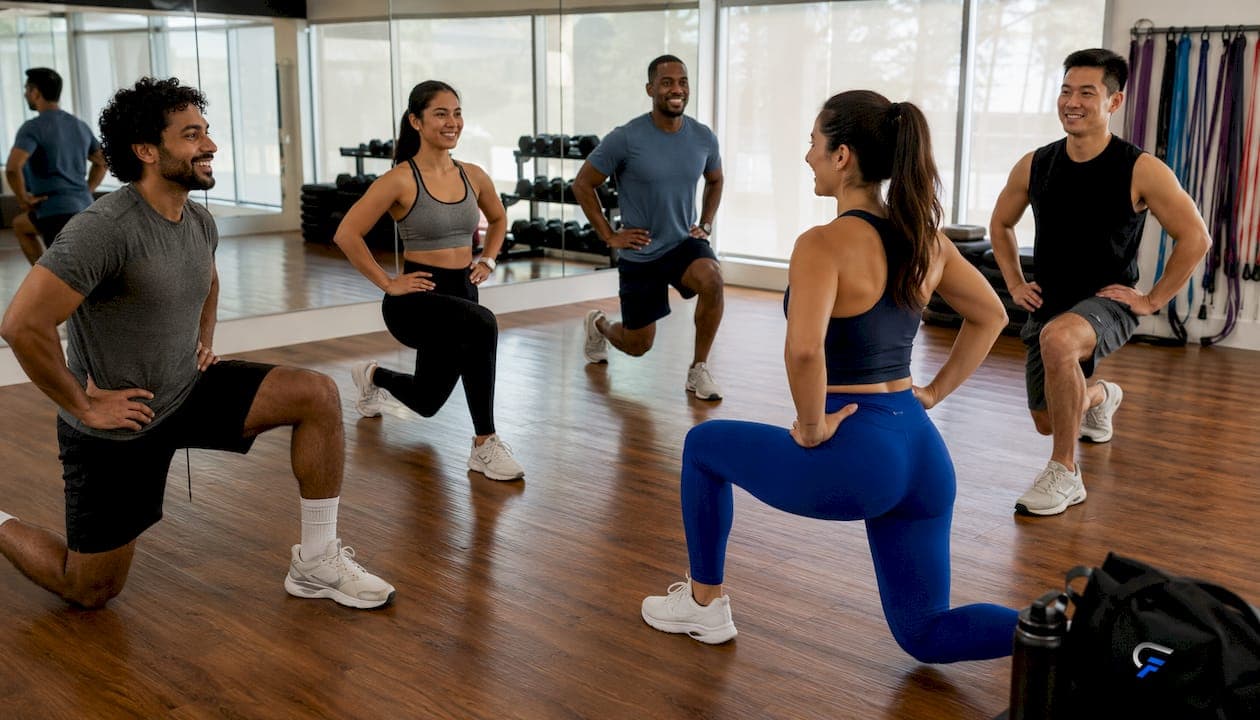
Small group personal training (SGPT) is coached, programme-driven exercise delivered to a small cohort, typically 2–6 people, where each participant receives tailored instruction rather than generic cues. It sits between a large group class and one-to-one personal training: more coaching attention than a packed studio, at a lower cost per session than private PT. If you want to find a vetted SGPT coach near you right now, search Yourcoachify to filter by location, speciality, and group size and book a taster session.
- Session cap: commonly a small number of participants allowing individual attention, sometimes more participants in boutique studio models
- Coach attention: the coach corrects your form, adjusts your load, and tracks your progress individually
- Cost: lower per-person than one-to-one PT, higher than a large group class
- Booking options: drop-in, block booking, monthly membership, or taster sessions
Pro Tip: Book a taster session before committing to a block. Most reputable SGPT providers offer a trial so you can assess the coach's style, the group dynamic, and whether the session cap genuinely allows for individual attention.
Table of Contents
- What small group personal training actually is
- Why people choose small group workouts
- What a typical session and programme include
- How group size affects the coaching you receive
- What does small group personal training cost in the UK?
- Who is small group training right for?
- What actually happens in your first SGPT session
- How SGPT differs from a standard group fitness class
- How to choose an SGPT programme and what to ask before you join
- How Yourcoachify helps you find vetted SGPT in the UK
- Key takeaways
- Why SGPT is worth taking seriously
- Find your SGPT coach on Yourcoachify
- Useful UK sources for checking coach qualifications
What small group personal training actually is
SGPT is personalised programming and hands-on coaching delivered inside a shared session. The coach writes a structured programme, assigns each participant appropriate loads and progressions, and corrects technique in real time. That is fundamentally different from a group fitness class, where the instructor leads a flow and individual correction is rare.
| Format | Group size | Individual coaching | Cost per session | Programme structure |
|---|---|---|---|---|
| One-to-one PT | 1 | Full | Highest | Fully bespoke |
| Small group PT | 2–6 | High | Mid-range | Shared block, individual scaling |
| Large group class | 10–30+ | Minimal | Lowest | Fixed class format |
- SGPT coaches pause the session to correct a single participant's technique with insights from biomechanics
- Programming progresses across blocks (typically 4–12 weeks), not class-by-class
- Each person's weights, reps, and modifications are tracked and adjusted
Why people choose small group workouts
The appeal is straightforward: you get a qualified coach watching your movement and adjusting your programme, but you share the cost with two to five other people. That combination is hard to replicate in a large class or on your own.
- Accountability: a small group notices when you skip; that social pressure is genuinely useful
- Shared motivation: training alongside others who are working hard raises your own effort level
- Safer progression: a coach who knows your current loads can spot when you are ready to progress or when you need to pull back
- Affordable personalisation: SGPT sits between full private training and a group class in both cost and coaching depth
- Community: small groups often develop real camaraderie over a programme block
Pro Tip: Tell your coach your goals and any niggles at the start of each block, not just at sign-up. Coaches can only individualise your programme with current information. A two-minute check-in before the first session of a new block makes a measurable difference to how well your plan is tailored.
What a typical session and programme include
Most SGPT programmes run in blocks of 4–12 weeks, with sessions two to three times per week. YMCA programmes describe small groups of 3–6 combining strength and conditioning across structured trainer-led sessions, which reflects the broad industry standard.
A single 60-minute session usually follows this shape:
- Arrival and check-in (5 minutes): coach notes any injuries, asks about energy levels, confirms today's focus
- Warm-up (10 minutes): movement prep specific to the session's main lifts or conditioning work
- Skill or technique work (10 minutes): practise the session's primary movement pattern before loading
- Main strength or conditioning block (25–30 minutes): working sets at individually prescribed loads, with the coach circulating and correcting
- Accessory or conditioning finisher (5–10 minutes): supplementary work targeting weak points or cardiovascular capacity
- Cool-down and debrief (5 minutes): coach reviews performance, notes weights lifted, and sets the target for next session
Progress tracking is built into the structure. Studios describe programming that progresses across blocks and includes measurements, staged load increases, and logged session data.
How group size affects the coaching you receive
Programmes typically cap groups at around four to six participants as a standard for effective technique correction. The smaller the group, the more time the coach can spend watching each person's movement.
| Group cap | Coach attention | Best for |
|---|---|---|
| Small groups of a few participants | Near-private | Complex technique, rehabilitation return |
| Groups of moderate size | High | Most goals: strength, fat loss, general fitness |
| Larger small groups | Moderate | Conditioning-focused, experienced participants |
- A cap of 4–6 allows the coach to observe every participant's key lifts within a single working set
- Groups above 8 make real-time technique correction difficult without a second coach
- Some providers offer private add-ons: a short one-to-one slot before or after a group session for specific skill work
Can you request a smaller group? Many providers will arrange semi-private sessions for two or three people at a slightly higher per-person rate. Ask directly when inquiring.
What does small group personal training cost in the UK?
Pricing varies widely by location, coach qualifications, session length, and group size. Urban sessions tend to be more expensive than those in regional areas. The cost per person is usually lower than one-to-one PT because coaching time is shared.

Sessions may be available as single drop-ins, blocks, monthly memberships, or taster sessions, with prices varying accordingly.
Prices tend to be higher in central locations, for smaller groups, longer sessions, specialist coaches, or when extras like nutrition guidance are included.
Some boutique studios offer unlimited monthly memberships suited for frequent training. Block bookings generally offer better value per session than drop-ins.
One-to-one PT is generally more expensive than SGPT on a per-person basis.
Pro Tip: Consider value in terms of coach attention and session length, not just upfront price.
Who is small group training right for?
SGPT suits a wide range of people, but it is not the right format for everyone.
Good fit:
- People who want coaching but cannot afford regular one-to-one PT
- Those who find solo gym sessions unmotivating
- Intermediate lifters who want structured programming and accountability
- Return-to-fitness clients who need technique guidance but enjoy a social environment
- Anyone who has felt lost in a large group class and wants more individual attention
Consider one-to-one PT instead if:
- You are managing a complex injury or post-surgical rehabilitation
- You need a fully bespoke programme that changes session by session
- You have very specific performance targets (competitive sport, elite strength goals)
A hybrid approach works well: many people train in a small group two or three times per week and book an occasional one-to-one session to address a specific technique issue or reassess their programme.
What actually happens in your first SGPT session
Knowing what to expect removes the anxiety of walking into something unfamiliar.
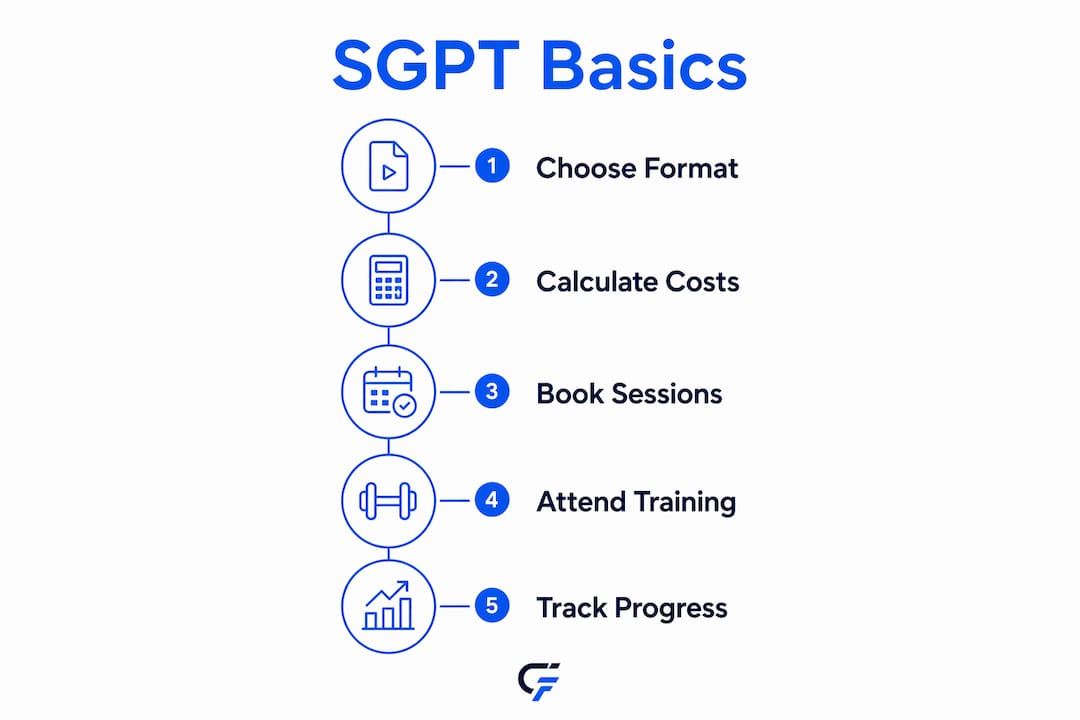
- Arrive five minutes early. Introduce yourself to the coach and mention any injuries, limitations, or goals you have not already shared.
- Coach briefing. The coach explains today's session structure and any scaling options relevant to the group.
- Tailored warm-up. Movement prep is chosen to match the session's main work, not a generic routine.
- Working sets with coaching. The coach circulates, corrects, and adjusts your load in real time. You will not be left to figure out weights on your own.
- Progress note. At the end, the coach logs what you lifted or achieved. This feeds directly into your next session's targets.
Bring water, appropriate footwear (flat-soled shoes for strength work), and a note of any current injuries. Communicating limitations honestly is the single most useful thing a first-timer can do.
Pro Tip: If the studio uses an app or session log, check it after each session. Reviewing your logged weights before the next session takes two minutes and means you arrive knowing your targets rather than guessing.
How SGPT differs from a standard group fitness class
The distinction matters because many people assume any coached group session is roughly the same.
- In a group fitness class, the instructor leads a flow; pausing to correct one person disrupts everyone else
- In SGPT, coaches will pause the session to correct an individual's technique because the group is small enough to absorb that without losing momentum
- Equipment is often pre-set or reserved for each participant, removing the queuing and equipment anxiety common in busy gyms
- Programming is planned across weeks, not invented class by class
- Your weights and progressions are logged; a group class has no memory of what you did last week
The pre-reserved equipment model used by professional SGPT providers is a practical advantage that is easy to overlook: you arrive to a station set up for you, which means the session starts on time and you spend the hour training, not searching for kit.
How to choose an SGPT programme and what to ask before you join
A good programme is easy to evaluate if you know what to look for.
Decision checklist:
- Group cap: is it stated clearly, and is it enforced?
- Coach qualifications: do they hold a Level 3 Personal Trainer qualification or above, and do they carry public liability insurance?
- Programming approach: is there a structured block with progressive overload, or is each session ad hoc?
- Progress measurement: how are your weights, body composition, or performance tracked?
- Trial policy: is there a taster session or short trial before a full block commitment?
- Cancellation terms: what happens if you miss a session or need to pause?
Questions to ask before booking:
- "What is your maximum group size, and how often do sessions reach that cap?"
- "What qualifications do your coaches hold, and are they insured?"
- "How do you track individual progress within a group session?"
- "Can I see a sample programme or session plan?"
- "Do you offer a taster session before I commit to a block?"
Comparing value beyond price means looking at coach qualifications and verified reviews alongside the session cap. A cheaper session in a group of ten with an unverified coach is not better value than a slightly pricier session in a group of four with a qualified, insured trainer.
How Yourcoachify helps you find vetted SGPT in the UK
Yourcoachify is a UK-wide marketplace where every coach profile includes verified reviews, listed qualifications, specialisms, and transformation galleries. You can filter by location (gyms in London, parks in Manchester, studios across the UK), speciality (weight loss, strength, pre/postnatal, nutrition), and session type.
Core platform benefits:
- Verified coach qualifications and insurance details on every profile
- Transparent pricing and session format information before you enquiry
- Transformation galleries and client reviews to assess real-world results
- Taster session booking available directly through the platform
How to search and book on Yourcoachify:
- Go to Yourcoachify and use the search function to enter your location
- Filter by speciality (e.g. strength training, fat loss) and session type (small group)
- Browse coach profiles: check qualifications, read verified reviews, and view transformation galleries
- Book a taster session directly through the profile to trial the coach before committing
Pro Tip: When reviewing a coach profile on Yourcoachify, check that the coach lists a Level 3 PT qualification or above, carries public liability insurance, and has reviews that specifically mention small group sessions rather than one-to-one work. Those three signals together give you a reliable picture of what to expect.
Key takeaways
Small group personal training is the most cost-effective way to access qualified, individualised coaching in the UK, provided you choose a programme with a clearly stated group cap, a qualified coach, and structured progressive programming.
| Point | Details |
|---|---|
| Group cap matters most | A cap of 4–6 gives meaningful coaching attention; above 8, individual correction becomes difficult. |
| Cost sits between formats | SGPT costs less per session than one-to-one PT while delivering far more coaching than a large group class. |
| Structured programming is the differentiator | Look for block-based programming with logged progress, not ad hoc sessions. |
| Try before you commit | Most reputable providers offer a taster session; always use it before booking a full block. |
| Yourcoachify simplifies the search | Filter by location and speciality on Yourcoachify to find verified SGPT coaches and book a taster in one place. |
Why SGPT is worth taking seriously
The conventional wisdom is that you either pay for proper coaching (one-to-one PT) or you accept a generic experience (group classes). SGPT challenges that assumption directly. A well-run group of four or five people, led by a qualified coach with a structured programme, delivers coaching quality that is genuinely close to private training at a fraction of the cost.
What people underestimate is how much the group dynamic contributes to consistency. Accountability to a coach is useful; accountability to three or four people who will notice your absence is more powerful in practice. The social element is not a consolation prize for not affording one-to-one PT. It is a distinct advantage.
The risk is in choosing poorly. A group of twelve with a coach who cannot see your movement is not SGPT in any meaningful sense. The group cap and the coach's qualifications are the two variables that determine whether you get real coaching or an expensive group class. Check both before you book.
Find your SGPT coach on Yourcoachify
Yourcoachify takes the guesswork out of finding a qualified small group personal training coach in the UK. Every profile on the platform shows verified qualifications, real client reviews, and clear pricing, so you can compare coaches honestly before spending a penny.
Search by your location and training goal, whether that is strength, fat loss, or returning to fitness after time off, and filter for small group sessions specifically. You will see coaches across London, Manchester, and beyond, each with the information you need to make a confident choice. Book a taster session directly through the platform and try the coach before committing to a full programme block.
Find your coach on Yourcoachify today and take the first step towards coached, structured training that actually fits your budget.
Useful UK sources for checking coach qualifications
Before booking any SGPT programme, it is worth knowing where to verify a coach's credentials independently.
- CIMSPA (Chartered Institute for the Management of Sport and Physical Activity): the UK's professional body for the sport and physical activity sector. Check whether a coach holds CIMSPA membership, which requires recognised qualifications and ongoing professional development.
- REPs (Register of Exercise Professionals): a voluntary register that lists fitness professionals who meet industry standards. Searching a coach's name on the REPs database confirms their qualification level and any specialisms.
- Ofqual-regulated awarding organisations: qualifications such as Level 3 Award in Personal Training are regulated by Ofqual. Recognised awarding bodies include Active IQ, YMCA Awards, and VTCT. A coach should be able to tell you which body awarded their qualification.
- DBS checks: if you are booking SGPT for a young person or a vulnerable adult, ask whether the coach holds a current DBS (Disclosure and Barring Service) check.
- Public liability insurance: any professional coach should carry public liability insurance. Ask to see evidence before your first session.
Yourcoachify coach profiles consolidate these signals in one place: qualifications, verified reviews, and specialisms are listed on every profile, saving you the time of checking each source separately. Use the platform as your starting point, then verify directly with the coach if you need additional reassurance.