

Strength training for runners is the process of systematically building muscular strength and stability to improve running efficiency and reduce injury risk. Runners who strength train 2–3 times per week reduce running-related injuries by up to 50%, with benefits appearing within 6–8 weeks. The key muscle groups are the glutes, calves, hamstrings, and core, all of which directly support running mechanics and propulsion. This guide covers how often to train, which exercises matter most, and how to build a progressive routine that fits around your running schedule.
How much strength training do runners actually need?
Two strength sessions per week is the right amount for most runners. Research confirms that two weekly sessions balance performance gains and running recovery without causing fatigue that spills into your runs. You do not need to spend hours in the gym to see results.
The total weekly time commitment is modest. 30–80 minutes split across two sessions is enough to improve performance and protect against injury. That is roughly two 20–40-minute sessions, which fits comfortably around a typical UK running schedule.
Timing your sessions well makes a real difference. Follow these guidelines to get the most from each session:
- Train on easy running days or rest days. Avoid scheduling heavy lifting on the same day as a hard interval or long run session.
- Lift after your run, not before. If you must combine both on one day, run first and lift afterwards to protect your running quality.
- Allow at least one full recovery day after a strength session before your next hard run.
- Reduce strength volume during high mileage weeks. When your running load increases, scale back the number of sets rather than dropping sessions entirely.
Pro Tip: Schedule your strength sessions on Monday and Thursday if you run hard on Tuesday and Saturday. This spacing gives your body enough time to recover between efforts.
What are the best strength exercises for runners?
The best exercises for runners target the muscles and movement patterns that running actually demands. Single-leg stability, hip control, calf strength, and trunk stiffness are the four pillars of a runner-specific strength programme. Generic gym routines built around bilateral lifts like the barbell back squat transfer less directly to running than most people assume.

Single-leg and split-stance exercises such as split squats, box step-ups, and single-leg Romanian deadlifts mirror running biomechanics and build stability under load. This specificity is why single-leg work consistently outperforms bilateral lifts for runners. Each step you take in a race is a single-leg movement, so your training should reflect that.
Here are the key exercises to include, grouped by muscle focus:
- Glutes and hips: Split squats, single-leg Romanian deadlifts, lateral band walks, and hip thrusts. The glute medius controls hip drop on each stride, and weakness here is a leading cause of knee and IT band problems.
- Calves and Achilles: Single-leg calf raises, both straight-leg and bent-knee variations. The Achilles tendon stores and releases energy with every foot strike, so loading it progressively is non-negotiable.
- Core and trunk: Planks, dead bugs, Pallof presses, and single-arm carries. Anti-rotation work and single-leg exercises control body position during fatigue, which protects your form in the final miles of a race.
- Hamstrings and posterior chain: Nordic curls, Romanian deadlifts, and glute-ham raises. Hamstring strength reduces the risk of strain and supports powerful hip extension.
- Often neglected areas: Foot intrinsic exercises, adductor squeezes, and tibialis raises. These small muscles absorb significant load across a training week and are frequently skipped.
| Exercise | Primary muscle | Running benefit |
|---|---|---|
| Split squat | Glutes, quads | Hip stability, single-leg strength |
| Single-leg calf raise | Gastrocnemius, soleus | Achilles loading, energy return |
| Romanian deadlift | Hamstrings, glutes | Hip extension, posterior chain strength |
| Dead bug | Deep core | Trunk stiffness, fatigue resistance |
| Lateral band walk | Glute medius | Hip control, knee alignment |
A balanced programme combining heavy resistance training, plyometrics, and corrective stability exercises outperforms any single method for injury prevention and running economy. Add low-level plyometrics such as pogo jumps and bounding once you have built a solid strength base.
How to structure a strength routine for runners
Progressive overload is the single most important principle in any strength programme. Repeating the same exercises without increasing load or difficulty leads to a plateau and loss of benefit. Your body adapts quickly, so you need to give it a reason to keep improving.
Follow this structure to build your routine safely and effectively:
- Start with bodyweight. Spend the first two to three weeks mastering movement quality before adding any external load. Poor technique under load causes injury, not strength.
- Add load gradually. Increase weight by the smallest available increment each week. A 2.5kg increase on a split squat is progress. You do not need large jumps.
- Work in a 4–8 rep range for primary lifts. Heavy resistance training at approximately 85% of one-rep max for 5–8 reps improves running economy by enhancing maximal strength and explosive power. This rep range builds the neuromuscular qualities runners need most.
- Track your sessions. Write down the weight, sets, and reps you complete each week. Tracking removes guesswork and shows you exactly when to progress.
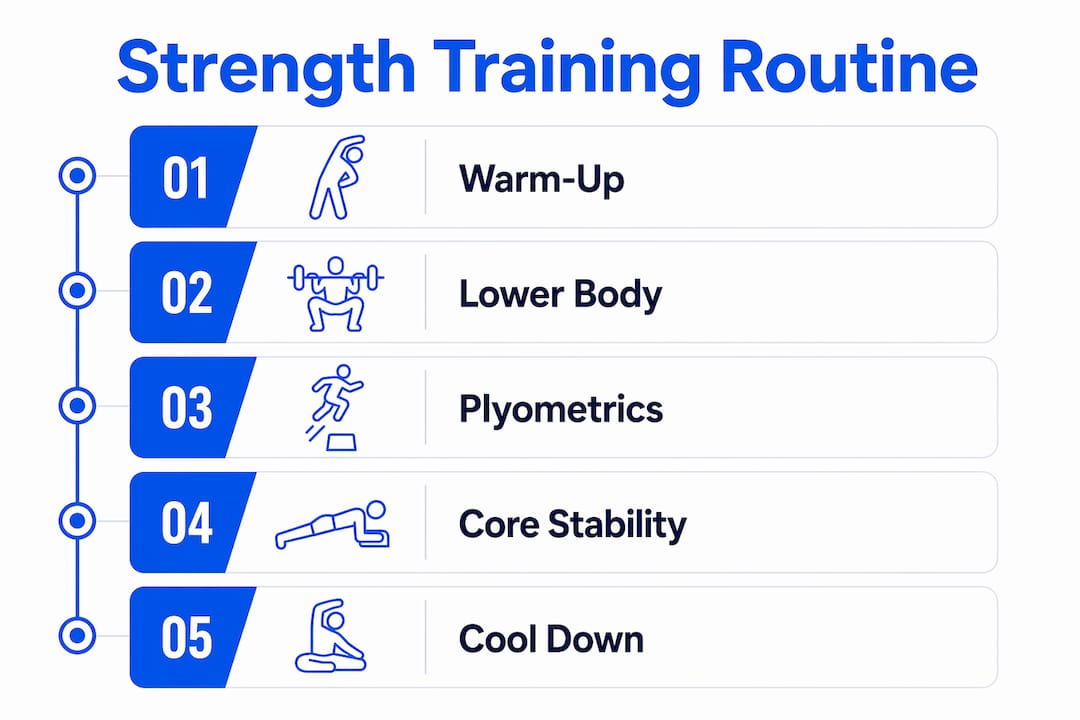
- Balance heavy lifts with plyometrics and corrective work. A typical session might include two heavy compound exercises, two single-leg exercises, one plyometric drill, and one corrective movement.
Pro Tip: Use a simple notebook or notes app to log each session. Seeing three consecutive weeks at the same weight is your signal to add load.
The table below shows how to distribute your weekly strength work across two sessions:
| Session | Focus | Example exercises |
|---|---|---|
| Session A | Lower body strength | Split squats, Romanian deadlifts, single-leg calf raises |
| Session B | Stability and power | Step-ups, dead bugs, lateral band walks, pogo jumps |
Common mistakes runners make with strength training
Most runners who struggle with strength training make the same errors. Recognising them early saves months of wasted effort.
- No progression. Doing the same bodyweight exercises week after week feels safe, but it stops producing results after the first few weeks. You need to increase the challenge consistently.
- Skipping single-leg work. Bilateral squats and leg presses are easier to load, but they do not replicate the demands of running. Single-leg exercises are harder and more specific. Do not avoid them.
- Neglecting calves, adductors, and feet. These areas absorb enormous cumulative load across a training week. Skipping them is a common reason runners develop Achilles tendinopathy and shin splints.
- Too much volume. More sets do not mean more progress. Excessive volume leads to poor recovery, flat runs, and eventually injury. Two to three working sets per exercise is enough.
- Fear of getting bulky. This concern stops many runners from lifting heavy enough to see real benefits.
Strength training at typical endurance training volumes does not cause significant muscle bulk. Instead, it improves neuromuscular stiffness, which enhances energy return at each foot strike and makes you a more efficient runner.
The fear of bulk is one of the most persistent myths in running. Endurance runners do not develop bulky muscles through measured strength training. What you gain is stiffness in the tendons and connective tissue, which translates directly into faster, more efficient running.
How to integrate strength training into your running plan
Fitting strength work into a running plan requires a clear weekly structure. The goal is to place strength sessions where they cause the least interference with your running quality.
- Pair strength with easy run days. Schedule your strength session on the same day as an easy run, either before or after. Easy days have low running stress, so adding strength work does not compromise recovery.
- Never lift heavily the day before a key run. A hard strength session 24 hours before a tempo run or long run will blunt your performance. Protect your quality sessions.
- Reduce strength volume during race build phases. As your weekly mileage climbs in the 6–8 weeks before a race, cut your strength sets by roughly a third. Keep the sessions but reduce the load on your body.
- Use strength training to build a buffer. Strength training builds a protective reserve capacity in muscles, tendons, and bones, allowing you to handle increased mileage or intensity without breaking down. Think of it as building a structural reserve that your running draws on.
- Maintain strength year-round. Dropping strength work entirely in the off-season means rebuilding from scratch each spring. One session per week is enough to maintain the gains you have built.
A simple weekly structure for a runner training four days per week might look like this: run Monday, strength Tuesday, run Wednesday, rest Thursday, run Friday, strength Saturday, long run Sunday.
Key takeaways
Strength training reduces running injuries by up to 50% and improves running economy when runners train consistently twice per week with progressive overload and single-leg exercises.
| Point | Details |
|---|---|
| Train twice per week | Two sessions of 30–80 minutes total is enough to improve performance and protect against injury. |
| Prioritise single-leg exercises | Split squats, step-ups, and single-leg deadlifts transfer directly to running mechanics. |
| Apply progressive overload | Increase load, reps, or difficulty each week to avoid plateaus and maintain adaptation. |
| Do not fear heavy lifting | Measured strength training builds neuromuscular stiffness, not bulk, improving energy return. |
| Integrate carefully | Schedule strength on easy days and reduce volume during high mileage or race build phases. |
What I have learned from watching runners strength train
The most common thing I see is runners treating strength work as an afterthought. They do a few bodyweight squats after a run, call it done, and wonder why nothing changes. Real results come from treating strength sessions with the same intention you bring to a track workout.
The runners who improve most consistently are the ones who accept that strength training feels uncomfortable at first. Your legs will feel heavy for the first two or three weeks. That is normal. It passes, and what replaces it is a resilience you can feel on every run.
The fear of bulk genuinely holds people back. I have seen runners avoid loading their single-leg exercises for months because they worried about their legs getting bigger. They did not get bigger. They got stronger, and their injury history shortened considerably.
Patience matters more than intensity here. You will not notice the benefits of strength training on your first run back. You will notice them six weeks in, when you finish a long run feeling less broken than usual, or when a niggle that used to flare up simply does not appear. That is the real return on your investment.
— The
Find a strength coach who understands running
Building an effective strength programme around your running takes more than a list of exercises. It takes someone who understands how your training week fits together, where your weaknesses are, and how to progress you safely without compromising your runs.

Yourcoachify connects you with UK-based personal trainers and strength coaches who specialise in working with runners. You can search by location, read verified reviews, check qualifications, and find a coach who fits your schedule and goals. Whether you train in a London gym or prefer sessions in a Manchester park, find your running coach on Yourcoachify and get a programme built around you.
FAQ
Is strength training good for runners?
Strength training reduces running-related injuries by up to 50% and improves running economy. Runners who train twice per week see measurable benefits within 6–8 weeks.
Will strength training make runners bulky?
Endurance runners do not develop significant muscle bulk through measured strength training. The main adaptation is improved neuromuscular stiffness, which enhances energy return and running efficiency.
How often should runners do strength training?
Two sessions per week is the recommended amount for most runners. This frequency improves durability and power without compromising running recovery.
What are the best strength exercises for runners?
Split squats, single-leg Romanian deadlifts, single-leg calf raises, lateral band walks, and dead bugs are among the most effective. These exercises target the glutes, calves, hamstrings, and core with running-specific movement patterns.
When should runners do strength training in their weekly schedule?
Schedule strength sessions on easy running days or rest days. Avoid heavy lifting the day before a key run such as a tempo session or long run.