

The quickest route to finding a qualified personal trainer in the UK is this: search a vetted marketplace or your local gym, confirm a CIMSPA-endorsed Level 3 qualification and public liability insurance, run a short interview, then book a single trial session before committing to a package.
Here is your immediate checklist:
- Where to search: Yourcoachify's marketplace, your gym's trainer list, or a trusted referral from someone whose results you respect.
- Credentials to check: CIMSPA-endorsed Level 3 Diploma in Personal Training and active CIMSPA membership.
- Insurance to confirm: Public liability and professional indemnity cover.
- Before you book: Ask three to five targeted questions about their specialism and assessment process.
- First commitment: One paid trial session only. No large packages until you are confident.
The sections below expand each step with UK-specific detail, realistic pricing, and a ready-to-use interview template.
Table of Contents
- Why hiring a personal trainer is worth it (and when it is not)
- How to find a personal trainer: the best search channels in the UK
- What qualifications and insurance should a UK trainer have?
- How to assess and interview a personal trainer before you commit
- What does personal training cost in the UK?
- What happens in the first session and how long until you see results?
- Online vs in-person training: which suits you?
- How to book a trial session and what to agree before you pay
- How Yourcoachify helps you find a vetted trainer faster
- Key takeaways
- Why I always recommend starting with a vetted marketplace
- Get started with Yourcoachify today
- Useful sources and further reading
Why hiring a personal trainer is worth it (and when it is not)
A trainer earns their fee when your goal is specific, complex, or has stalled. Weight loss with a medical backdrop, returning to training after injury, preparing for a first powerlifting competition — these are situations where guesswork is genuinely costly. A good trainer brings structured programming, real-time technique correction, and the kind of accountability that is hard to replicate alone.
The outcomes trainers reliably deliver are:
- A progressive programme built around your current ability, not a generic template.
- Technique coaching that reduces injury risk from day one.
- Regular check-ins that keep you consistent when motivation dips.
- Honest feedback on nutrition scope and when to refer you to a registered dietitian.
According to fitness experts, specialism alignment and coaching style are as important as formal qualifications when it comes to long-term adherence. A trainer who is brilliant with athletes but inexperienced with postnatal clients is the wrong fit, regardless of their certificate count.
Where a trainer is less necessary: if you already train consistently, understand progressive overload, and simply want more variety, a well-structured app or a group class may serve you just as well for a fraction of the cost.
Pro Tip: Two sessions per week tends to be the sweet spot for most goals. One session rarely builds enough momentum; three or more can stretch a budget unsustainably. Start with two and reassess after six weeks.
How to find a personal trainer: the best search channels in the UK
The fastest, most reliable starting point is a vetted marketplace that surfaces verified qualifications and client reviews in one place. That said, each channel has its own strengths, and the right one depends on your situation.

| Channel | Ease of search | Trust signals | Typical cost expectation |
|---|---|---|---|
| Vetted marketplace (e.g. Yourcoachify) | High — filters by location, specialism, price | Verified qualifications, reviews, transformation galleries | Varies; transparent per-profile |
| Gym-employed trainer | Medium — ask at reception or check the gym's website | Gym vets trainers; standards vary by facility | Often bundled with membership; can be higher |
| Self-employed / independent trainer | Lower — requires more legwork | You verify everything yourself | Often more flexible on price |
| Social media (Instagram, TikTok) | Easy to browse; hard to verify | Follower count is not a credential | Highly variable |
| Personal referral | High trust, low effort | Friend's lived experience | Same as independent rates |
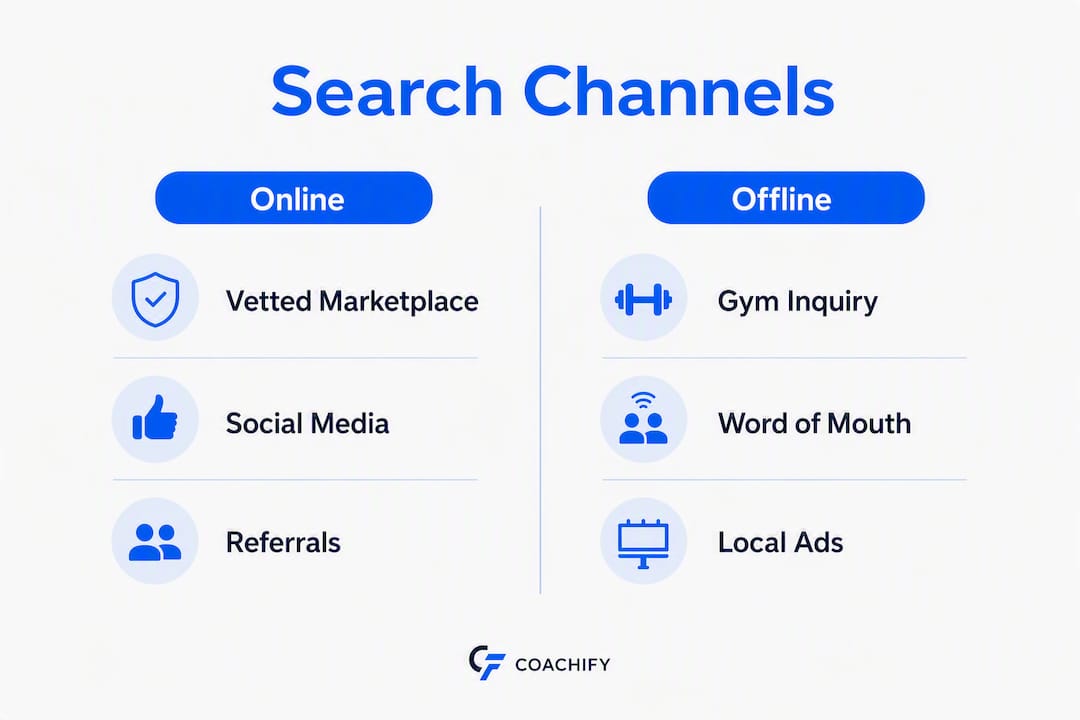
Vetted platforms list qualifications, specialisms, verified reviews and transformation galleries, which cuts the time you would otherwise spend chasing certificates by email.
Using a marketplace: Apply filters for your location, your primary goal (weight loss, strength, rehabilitation, pre/postnatal), and your preferred session format (in-person or online). Read at least three client reviews and check that the profile lists a named qualification, not just "certified."
Using your gym: Ask the fitness manager, not just the front desk. Request to see the trainer's qualification certificate and ask whether they carry their own insurance or rely solely on the gym's cover.
Using social media: Treat it as a discovery tool only. A polished Instagram feed tells you nothing about programming quality. Move any candidate you find there through the same verification steps as anyone else.
Using referrals: The most underrated channel. A friend who has achieved a goal similar to yours with a specific trainer is stronger evidence than any review platform. Ask what the trainer's assessment process was like, not just whether they liked the sessions.
What qualifications and insurance should a UK trainer have?
The baseline in the UK is a CIMSPA-endorsed Level 3 Diploma in Personal Training. Trainers who hold this qualification and maintain CIMSPA Practitioner membership have met the sector's minimum standard and are committed to ongoing continuing professional development (CPD).
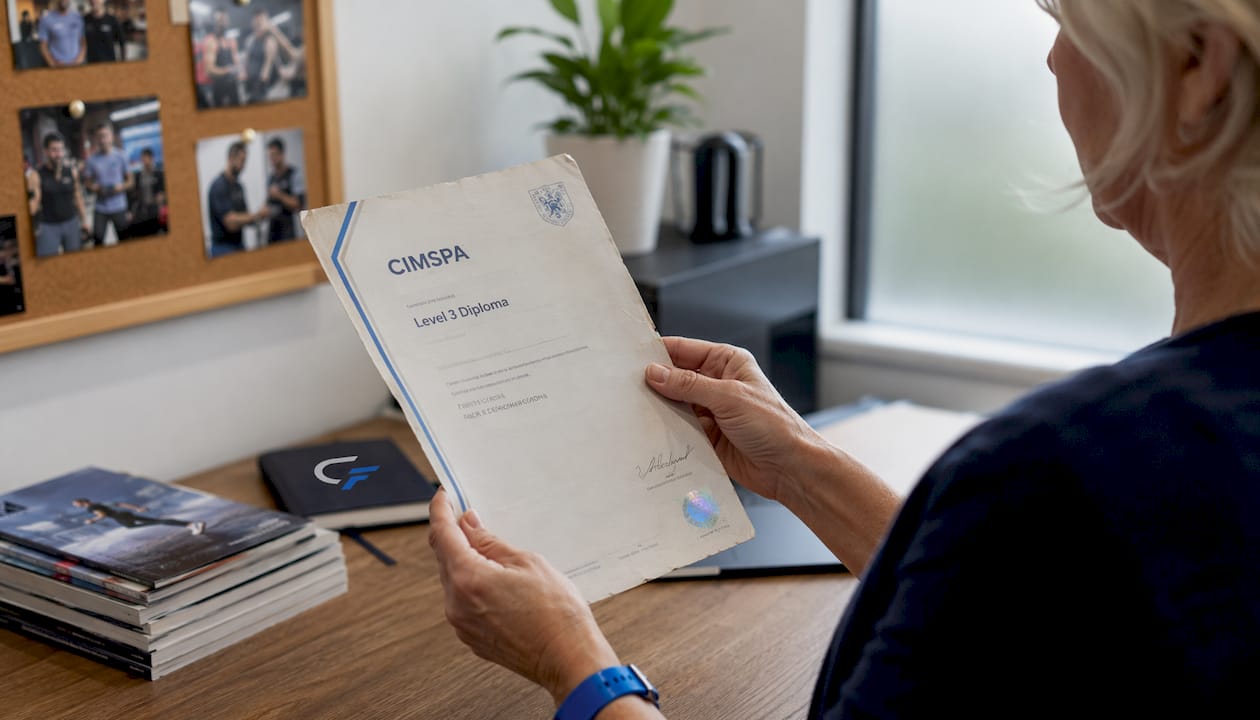
One thing many people do not realise: personal trainers are not statutorily regulated in the UK. Unlike physiotherapists, who appear on the Health and Care Professions Council (HCPC) register, a PT can legally work without any formal qualification. That makes independent verification non-negotiable. You can check the HCPC register to confirm whether a trainer also holds a regulated allied health profession (relevant if they claim physiotherapy or dietetic credentials), but for PT qualifications specifically, you need to ask for the certificate directly.
For a deeper look at UK qualification routes, the Skills England personal trainer standard lists the approved awarding bodies: Active IQ, Pearson BTEC, VTCT Skills, and YMCA Awards all offer recognised Level 3 routes.
Your pre-booking checklist:
- Ask to see the Level 3 certificate (the awarding body name should be on it).
- Confirm CIMSPA Practitioner membership — you can search the CIMSPA directory online.
- Ask specifically about CPD completed in the last 12 months.
- Request proof of public liability insurance (public liability insurance is commonly required, with coverage typically in the millions).
- Ask whether they also hold professional indemnity insurance.
- If nutrition advice is part of the offer, check their scope — a PT can give general guidance, but clinical dietary advice requires a registered dietitian. For more on this boundary, the personal trainer meal plans guide explains what to expect.
Pro Tip: Ask for a copy of their insurance certificate, not just a verbal confirmation. A reputable trainer will send it without hesitation. Hesitation itself is useful information.
How to assess and interview a personal trainer before you commit
Use a short, structured interview and a simple scoring template to compare candidates objectively. This takes 15–20 minutes and saves you from a poor fit that costs both money and motivation.
Sample interview questions
- How long have you been working as a personal trainer, and what client types do you work with most?
- What is your specific experience with [your goal: weight loss / strength / rehabilitation / pre/postnatal]?
- Walk me through what happens in our first session.
- How do you track client progress between sessions?
- What does a typical 12-week programme look like for someone at my level?
- Do you carry public liability and professional indemnity insurance?
- Can you share your Level 3 certificate and CIMSPA membership details?
- How do you handle sessions if a client hits a plateau?
- What is your cancellation and rescheduling policy?
- Do you have any current or former clients I could speak with?
Questions 3 and 5 are the most revealing. A trainer who cannot describe their assessment process or who jumps straight to "we'll do a HIIT session" has not thought carefully about your individual needs. A quality first session is an assessment, not a workout — reputable trainers perform a detailed initial assessment and build a progressive plan before delivering high-intensity work.
Simple scoring template
Copy this and score each candidate 1–5 per row:
A total score below 25 is a signal to keep looking.
Red flags to watch for
- No mention of a health screen or PAR-Q before starting sessions.
- Evasive or vague answers about qualifications ("I'm certified" without naming the awarding body).
- Pressure to buy a large block of sessions in the first conversation.
- No client references available.
- Promises of specific weight-loss figures or timelines without knowing your history.
What does personal training cost in the UK?
Typical UK rates vary significantly by location and format. Outside London, one-to-one sessions generally run £35–£65 per session; in London and other premium markets, expect £50–£120 or more. Online coaching and small-group training offer lower entry points.
| Format | Typical price range | Notes |
|---|---|---|
| 1:1 session (outside London) | £35–£65 per session | Most common starting point |
| 1:1 session (London / premium) | £50–£120+ per session | Central London at the higher end |
| Block booking (10+ sessions) | 10–20% discount off per-session rates | Confirm expiry terms before paying |
| Online coaching | £50+ per month | Varies widely by programme depth |
| Small-group training | £10–£25 per person per session | Good value for accountability-focused goals |
For a detailed breakdown of London-specific pricing, the personal trainer cost in London guide covers what to expect across different boroughs and gym types.
Block bookings often carry a 10–20% discount but frequently come with expiry windows of around 12 weeks. Always confirm the expiry date, the rescheduling policy, and what happens to unused sessions if you need to pause.
Pro Tip: Ask for session length, what is included (assessment, programming, follow-up check-ins), package expiry terms, and the cancellation policy before you pay anything. Small differences in these terms can make a significant difference to the value you actually receive.
What happens in the first session and how long until you see results?
The first session is an assessment, not a workout. A good trainer uses it to understand your starting point and build a plan — not to impress you with intensity. If a trainer skips straight to hard training without any screening, that is a red flag.
A quality first session should generally include a health screen, movement assessment, and goal discussion, with a plan outlined
- A PAR-Q (Physical Activity Readiness Questionnaire) or equivalent health screen.
- A movement assessment to identify any mobility restrictions or imbalances.
- A conversation about your goals, history, and lifestyle (sleep, stress, nutrition habits).
- Agreement on session frequency and format.
- A written short-term plan or at least a verbal outline of the first four weeks.
Absence of any health screening is a strong safety concern, not just a quality issue.
Realistic timelines for common goals:
- General fitness and energy: Noticeable improvement in 4–6 weeks with consistent sessions.
- Strength gains: Measurable increases in 6–8 weeks; visible changes typically take 10–12 weeks.
- Weight loss: Sustainable fat loss is gradual. Expect meaningful change over 8–12 weeks when training is combined with dietary adjustments.
- Rehabilitation or injury recovery: Highly variable; depends on the injury, severity, and whether you are also working with a physiotherapist.
Progress speed depends on multiple factors including session frequency, adherence, rest, and nutrition; dramatic results over a very short period are unrealistic.
Online vs in-person training: which suits you?
Match the format to your goals first, then consider convenience and cost. Technique-heavy goals (Olympic lifting, rehabilitation, learning new movement patterns) genuinely benefit from in-person coaching where a trainer can physically cue and correct you. Programming, accountability, and general fitness goals can work very well online.
| Factor | Online | In-person |
|---|---|---|
| Cost | Generally lower | Higher, especially in cities |
| Convenience | High — train anywhere, any time | Requires travel to a venue |
| Hands-on correction | Not possible | Core advantage |
| Accountability | Depends on check-in structure | Built into the session format |
| Best for | Programming, habit building, remote clients | Technique, rehab, beginners |
When evaluating an online trainer, ask for a sample programme to assess its structure and progression. Check how often they review form (video submission, live video calls), how quickly they respond to messages, and whether they adjust the programme based on feedback. A trainer who sends a static PDF and disappears is not coaching — they are selling a document.
For a full comparison of the best online options available in the UK, the best online personal trainers guide covers what to look for and how to vet quality remotely. If a hybrid model appeals — some sessions in person, some remote — the hybrid personal training guide explains how that structure works in practice.
How to book a trial session and what to agree before you pay
Always book a single paid session first. Never commit to a multi-session package with a trainer you have not yet worked with, regardless of how good their profile looks.
Step-by-step booking process
- Shortlist two or three candidates from your chosen search channel.
- Send a brief message (see the template below) asking about availability for a trial session and confirming they cover your goal area.
- Confirm the session details in writing: date, time, location, duration, cost, and what the session will include.
- Ask about the assessment steps before you arrive — a good trainer will tell you to bring comfortable kit and will mention a health questionnaire.
- Attend the trial with your scoring template from the interview section in mind.
- After the session, decide whether the communication style, programming approach, and overall feel are right for you before discussing packages.
Message template
Short, direct, and it filters out trainers who are evasive about credentials before you spend a penny.
How Yourcoachify helps you find a vetted trainer faster
Vetted marketplaces reduce the risk of a poor hire by surfacing qualifications, reviews, and transformation galleries in one searchable place. Instead of chasing certificates by email or relying on a gym receptionist's recommendation, you can compare verified profiles side by side.
Yourcoachify is built specifically for this. Every coach profile on the platform includes:
- Verified qualifications (including Level 3 status).
- Filters for specialism: weight loss, strength, pre/postnatal, nutrition coaching, and more.
- Location-based search covering gyms, parks, and studios across the UK, from London to Manchester.
- Verified client reviews and transformation galleries.
- Online and in-person booking options.
"Using a vetted marketplace shortens discovery time by surfacing verified qualifications and client transformation galleries, helping buyers compare objectively." — Simply Link Pricing Guide
To use the platform safely, apply the specialism filter before browsing names. Read at least three reviews per profile, and check that the qualification listed matches a recognised awarding body. If you are searching for a specialist, such as a female personal trainer in London or a coach in Manchester, the location and gender filters narrow results quickly.
Pro Tip: Use the transformation gallery as a secondary signal, not a primary one. A gallery shows results; the qualification and review sections tell you whether those results were achieved safely and consistently.
For a deeper look at what UK qualifications actually mean and how to read a trainer's CV, the personal trainer qualifications guide covers every recognised route in plain language.
Key takeaways
Finding the right personal trainer comes down to verifying credentials, matching specialism to your goals, and testing fit before committing financially.
| Point | Details |
|---|---|
| Check CIMSPA Level 3 first | The CIMSPA-endorsed Level 3 Diploma is the UK sector minimum — verify the certificate and membership before booking. |
| Confirm insurance | Ask for written proof of public liability and professional indemnity cover; do not accept verbal assurance alone. |
| Use a structured interview | Score candidates on specialism, assessment process, communication, availability, and price using a simple 1–5 template. |
| Expect a proper first session | The first session should include a PAR-Q health screen, movement assessment, and a written plan — not an immediate hard workout. |
| Yourcoachify saves search time | The marketplace lists verified qualifications, reviews, and transformation galleries so you can compare UK trainers in one place. |
Why I always recommend starting with a vetted marketplace
The most common mistake people make when choosing a personal trainer is prioritising proximity or price over fit. A trainer who is five minutes away and charges £40 a session is a poor investment if their specialism is athletic performance and your goal is postnatal recovery.
A vetted marketplace changes the starting point. Instead of filtering by convenience and hoping for the best, you begin with verified credentials and client evidence, then narrow by location and price. That order matters. It means you are comparing genuinely qualified candidates rather than whoever happened to be available at your gym on a Tuesday.
That said, a marketplace profile is not a substitute for your own judgement. Read the reviews critically. Look for patterns across multiple clients, not just the most recent five-star rating. Ask the questions from the interview section above, even when a profile looks perfect. The platform shortens the search; you still make the final call.
For readers in specific locations, resources like the best personal trainers in Manchester guide show how the search plays out in practice, with real examples of how clients have matched with coaches through the platform.
Get started with Yourcoachify today
Searching for a qualified personal trainer across the whole of the UK used to mean hours of gym visits, unanswered emails, and hoping a friend knew someone good. Yourcoachify cuts that down to minutes.
Every coach on the platform has a verified profile showing their qualifications, client reviews, and transformation galleries. You filter by your goal, your location, and your preferred format. You compare real evidence. Then you book a trial session directly, with no pressure to commit to a package first.

Three steps to get started:
- Search by specialism and location at yourcoachify.com — use the filters for weight loss, strength, pre/postnatal, or nutrition.
- Compare profiles — check the qualification listed, read at least three reviews, and look at the transformation gallery.
- Book a single trial session — confirm the assessment steps in advance, then decide on a package only once you are confident in the fit.
Before you book, check the profile for: a named Level 3 awarding body, at least three verified reviews, a stated specialism that matches your goal, and a clear session format (in-person or online). If any of these are missing, message the coach directly to ask.
Useful sources and further reading
| Resource | What it covers | Why it matters |
|---|---|---|
| CIMSPA Personal Trainer Standard | The UK sector minimum qualification and CIMSPA membership criteria | Confirms what Level 3 means and how to verify a trainer's status |
| Skills England — Personal Trainer Occupation | Lists all approved Level 3 awarding bodies in the UK | Helps you identify whether a named qualification is officially recognised |
| HCPC Register Check | How to verify regulated health professionals (physiotherapists, dietitians) | Useful if a trainer also claims a regulated allied health credential |
| NHS England — Physical Activity | NHS guidance on physical activity and signposting to community resources | Relevant context for readers with health conditions seeking NHS-aligned activity support |
| Simply Link — UK PT Pricing Guide | Typical UK personal training rates by format and location | Sets realistic price expectations before you approach a trainer |
This article provides general information to help you make an informed choice. It is not professional medical or fitness advice. If you have a health condition, injury, or specific clinical need, confirm your exercise plans with your GP or a relevant registered health professional before starting.