
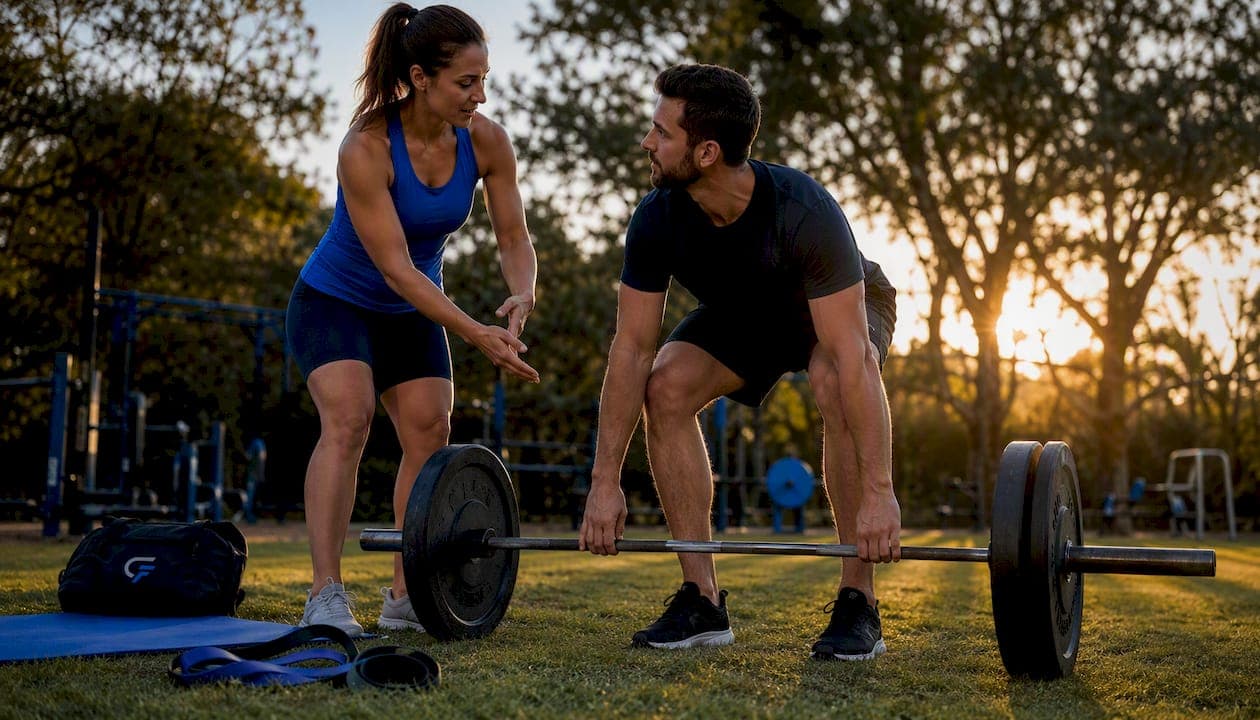
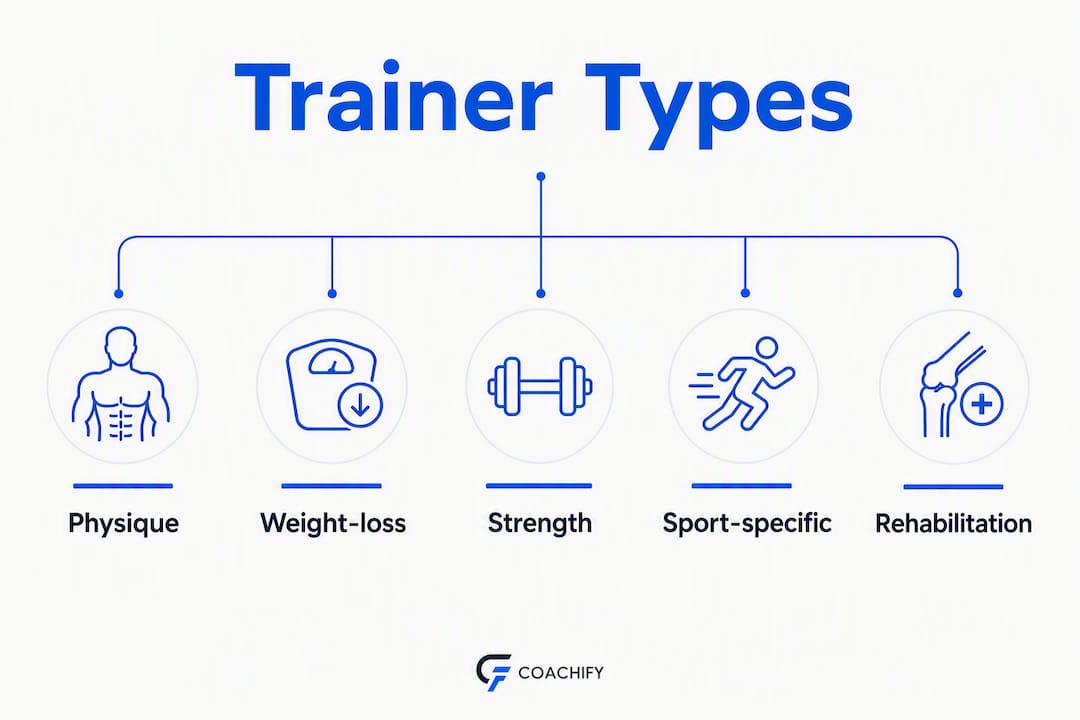
There are ten main types of personal trainers, and choosing the right one comes down to a single rule: match the trainer's specialism to your primary goal. A physique-focused coach, a weight-loss specialist, a strength and conditioning coach, a sport-specific trainer, a rehabilitation or clinical exercise professional, a wellness and behaviour coach, a group or bootcamp instructor, an online or hybrid trainer, a pre/postnatal specialist, and a senior-focused trainer each serve a distinct purpose. Mismatching your goal to a trainer's lane is the most common and most avoidable mistake people make.
Three factors narrow the shortlist quickly: your primary goal (performance, appearance, clinical need, or habit change), your preferred setting (gym, home, online, or group), and the trainer's verified qualifications. CIMSPA is the UK's professional body for fitness and physical activity, and its register is the most reliable place to confirm a trainer's credentials. The NHS physical activity guidelines and UK Active research both underpin the evidence base that reputable trainers work from.
Quick next steps:
- Identify your primary goal before you search (fat loss, strength, sport, rehabilitation, or general health).
- Check any shortlisted trainer's qualifications against the CIMSPA register or ask to see their certification ID directly.
Table of Contents
- What are the main types of personal trainers?
- How do the main trainer categories compare?
- What qualifications should a UK trainer have?
- How to choose the right trainer for your goal
- Where and how do UK trainers deliver their services?
- Thinking about becoming a trainer? Here is how to specialise
- Key takeaways
- Why specialism alignment matters more than most people realise
- Find your matched trainer on Yourcoachify
- Useful sources and further reading
What are the main types of personal trainers?
The ten trainer specialisms below each have a distinct client profile, a typical qualification level, and clear signs of credibility. Scan the entries that match your goal, then use the comparison table in the next section to shortlist.
1. Physique and body-composition trainer
This trainer focuses on aesthetics: muscle definition, fat loss, and body-shape change. Their typical client wants to look and feel different, not necessarily to run faster or lift a competition total. Sessions usually combine resistance training with structured cardio and are often paired with nutrition guidance.
Best for: Anyone whose primary goal is changing how their body looks or feels, from someone wanting to lose a stone to a competitive bodybuilder.
Qualifications to expect: Level 3 Personal Trainer as a minimum; many hold a nutrition coaching certificate such as NASM's Certified Nutrition Coach (CNC).
Red flag: A trainer who promises a specific body-fat percentage by a fixed date without a proper initial assessment.
2. Weight-loss and lifestyle coach
Distinct from a pure physique trainer, this specialist focuses on sustainable behaviour change: building habits, managing energy balance, and addressing the lifestyle factors that drive weight gain. They tend to spend more session time on goal-setting, accountability check-ins, and nutrition planning than on pure exercise programming.

Best for: Clients who have tried diets or gym memberships without lasting results and need structured accountability alongside exercise.
Qualifications to expect: Level 3 PT plus a recognised nutrition or health-coaching qualification. Look for CIMSPA-endorsed CPD in behaviour change.
Red flag: Any trainer who prescribes a very low-calorie diet without referring you to a registered dietitian.
3. Strength and conditioning coach
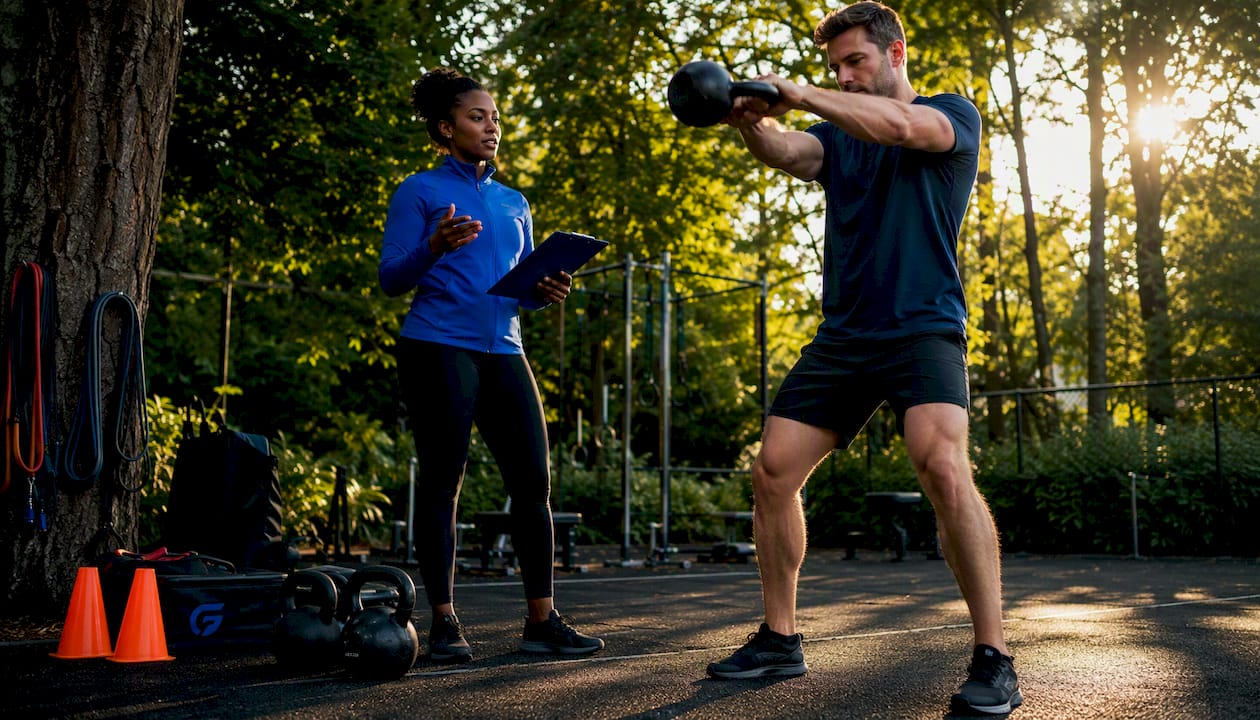
Personal trainers serve the general population with broad health goals, while strength and conditioning coaches focus on athletic performance metrics such as sprint speed, vertical jump, and power output. This distinction matters practically: an S&C coach programmes periodised training blocks, tracks performance data, and often works alongside sports medicine staff.
Best for: Athletes, sports teams, and anyone whose goal is measurable performance improvement rather than general fitness.
Qualifications to expect: Level 4 Strength and Conditioning in the UK; many also hold NSCA-CSCS or UKSCA accreditation. Employers and sporting institutions commonly expect Level 4 for performance roles.
Red flag: A trainer calling themselves an S&C coach who cannot explain periodisation or show athlete references.
4. Sport-specific trainer
Similar to an S&C coach but narrower in focus, a sport-specific trainer designs programmes around the demands of one sport: a tennis player's rotational power, a cyclist's threshold capacity, or a rugby player's contact strength. They understand the movement patterns, energy systems, and injury risks of that sport.
Best for: Recreational or competitive athletes who want training that directly transfers to their sport.
Qualifications to expect: Level 3 PT plus sport-specific CPD or a coaching licence in the relevant sport. NASM's Performance Enhancement Specialisation (PES) is widely recognised.
Red flag: A trainer with no demonstrable background in your sport who relies on generic fitness programming.
5. Rehabilitation and clinical exercise trainer
Clients with clinical or complex health needs should seek specialists such as Certified Special Population Specialists or Clinical Exercise Physiologists who bridge fitness and healthcare. These professionals are appropriate for post-surgery recovery, chronic conditions such as type 2 diabetes or cardiovascular disease, and post-rehabilitation programmes after physiotherapy.
Best for: Anyone with a diagnosed medical condition, a recent injury, or a referral from a GP or physiotherapist.
Qualifications to expect: Level 4 Exercise Referral or a clinical exercise physiology degree; NSCA's Certified Special Population Specialist (CSPS) is a recognised advanced credential.
Red flag: A trainer without clinical qualifications who claims to treat or rehabilitate medical conditions independently.
6. Wellness and holistic coach
This trainer takes a wider view of health: sleep, stress, mindset, and nutrition sit alongside movement. They often hold qualifications in behaviour change, mindfulness, or health coaching, and their sessions may look more like structured conversations than traditional workouts.
Best for: Clients experiencing burnout, chronic stress, or poor sleep who need lifestyle restructuring rather than a hard training programme.
Qualifications to expect: Level 3 PT plus a recognised health-coaching or behaviour-change qualification. CIMSPA-endorsed wellness CPD is a useful marker.
Red flag: A coach who makes clinical mental-health claims without appropriate referral pathways.
7. Group, bootcamp, and CrossFit instructor
Group fitness trainers lead sessions of anywhere from four to thirty people, combining structured programming with community energy. Bootcamp instructors typically work outdoors or in studio settings; CrossFit coaches operate within a licensed affiliate framework with specific methodology training.
Best for: Clients who are motivated by group accountability, prefer lower per-session costs, or enjoy a social training environment.
Qualifications to expect: Level 2 Fitness Instructor as a minimum for group exercise; CrossFit L1 or L2 for CrossFit-specific coaching. Small-group formats often sit between one-to-one and large group in both cost and attention.
Red flag: A group instructor who never adapts exercises for participants with different ability levels or injuries.
8. Online and hybrid personal trainer
Hybrid models combining in-person technique coaching with online programming often offer better cost-effectiveness and scale for clients who need both hands-on tuition and ongoing accountability. A purely online trainer delivers everything remotely: video check-ins, app-based programming, and written feedback. A hybrid trainer blends occasional face-to-face sessions with ongoing digital support.
Best for: Busy professionals, people in rural areas with limited local options, or anyone who wants expert-led programming at a lower price point than weekly one-to-one sessions.
Qualifications to expect: The same Level 3 PT standard applies; look for trainers who use structured platforms for programme delivery rather than informal WhatsApp messages.
Red flag: A trainer who cannot demonstrate how they assess technique remotely or who offers no video feedback mechanism.
9. Pre/postnatal specialist
Pregnancy and the postnatal period require specific knowledge of physiological changes, contraindicated exercises, and safe progression. A pre/postnatal specialist understands pelvic floor considerations, diastasis recti, and how to modify programming across trimesters and postpartum recovery stages.
Best for: Women who are pregnant or within the first year postpartum and want safe, evidence-based exercise support.
Qualifications to expect: Level 3 PT plus a recognised pre/postnatal exercise qualification (CIMSPA-endorsed options exist from several UK providers). A DBS check is advisable given the vulnerability of this client group.
Red flag: Any trainer who has not completed specific pre/postnatal training and cannot explain pelvic floor considerations.
10. Senior and older-adult specialist
Training older adults requires understanding of age-related changes in muscle mass, bone density, balance, and cardiovascular capacity. A senior specialist programmes for fall prevention, functional independence, and chronic-condition management, often working alongside GP referral schemes.
Best for: Adults aged 60 and over, or anyone with age-related conditions such as osteoporosis or reduced mobility.
Qualifications to expect: Level 3 PT plus a Level 4 Exercise Referral or a recognised senior fitness qualification. NASM's Senior Fitness Specialisation (SFS) is one widely cited option. A DBS check is standard when working with older adults. See the UK guide to personal training for seniors for a deeper look at what to expect.
Red flag: A trainer who applies the same programming to a 70-year-old as to a 30-year-old without modification.
How do the main trainer categories compare?
| Trainer type | Best for | Typical setting | UK qualifications needed | Session format | Typical price band | Evidence of success |
|---|---|---|---|---|---|---|
| Physique/body-composition | Aesthetic change, muscle gain, fat loss | Gym, studio | Level 3 PT, nutrition CPD | 3–5 x weekly, 1:1 | Mid | Transformation gallery, body-composition measurements |
| Weight-loss/lifestyle | Sustainable fat loss, habit change | Gym, online, home | Level 3 PT, behaviour-change CPD | 2–3 x weekly, 1:1 or hybrid | Mid | Progress photos, habit-tracking data |
| Strength and conditioning | Athletic performance, sport metrics | Gym, sports facility | Level 4 S&C, NSCA-CSCS or UKSCA | Periodised blocks, 3–5 x weekly | Mid–High | Performance data (sprint times, power output) |
| Sport-specific | Recreational or competitive athletes | Sports facility, gym | Level 3 PT + sport CPD or PES | Sport-cycle aligned, 2–4 x weekly | Mid–High | Sport-performance benchmarks, athlete references |
| Rehabilitation/clinical | Post-injury, chronic conditions, GP referral | Clinical setting, gym | Level 4 Exercise Referral, CSPS | 1–2 x weekly, 1:1 | High | Clinical outcome measures, GP/physio collaboration |
| Group/bootcamp | Social motivation, budget-conscious | Outdoor, studio | Level 2 Fitness Instructor | Group, 2–4 x weekly | Low | Attendance retention, group progress metrics |
| Online/hybrid | Busy schedules, remote access | Online, occasional gym | Level 3 PT | Flexible, weekly check-ins | Low–Mid | App-based progress tracking, video reviews |
| Pre/postnatal | Pregnant or postpartum women | Home, studio, online | Level 3 PT + pre/postnatal CPD, DBS | 2–3 x weekly, 1:1 or small group | Mid | Safe progression records, postnatal recovery milestones |
| Senior/older adult | Adults 60+, fall prevention, functional fitness | Home, gym, community | Level 3 PT + Level 4 or senior CPD, DBS | 2–3 x weekly, 1:1 | Mid | Functional movement scores, GP referral outcomes |
Reading the table: "Price band" is relative to the UK market. Low typically means group or online sessions where cost is shared or overheads are minimal. Mid covers most one-to-one gym-based sessions. High reflects clinical expertise, specialist settings, or performance-sport contexts where demand for qualified practitioners exceeds supply. "Required qualifications" refers to the UK Regulated Qualifications Framework (RQF) levels endorsed by CIMSPA, not international equivalents, though internationally recognised credentials such as NSCA-CSCS are noted where they are standard in that specialism.
What qualifications should a UK trainer have?
The UK fitness sector follows a clear qualification ladder, and knowing it helps you check credentials confidently, whether you are hiring a trainer or planning a career.
The core UK ladder:
- Level 2 Fitness Instructor: the entry point, covering gym-floor instruction and group exercise. Required before progressing to Level 3.
- Level 3 Personal Trainer: the standard qualification for one-to-one coaching. Covers programme design, client assessment, and basic nutrition principles. This is the minimum you should accept from any trainer you hire for personal sessions.
- Level 4 Specialist: covers advanced areas including strength and conditioning, exercise referral, and sports nutrition. Level 4 is the standard employers and sporting institutions expect for performance and clinical roles.
Mandatory safety credentials: Every practising trainer should hold a current first-aid certificate (typically Emergency First Aid at Work or equivalent) and CPR/AED training. Trainers working with vulnerable groups, including children, older adults, and pre/postnatal clients, should hold a valid DBS (Disclosure and Barring Service) check.
Adding specialisms: Specialisms are typically gained through accredited short courses or CPD programmes after Level 3. NASM's Corrective Exercise Specialisation (CES), Performance Enhancement Specialisation (PES), and Certified Nutrition Coach (CNC) are widely recognised internationally and accepted by many UK employers. CIMSPA endorses a range of UK-based CPD providers, and its register lists trainers who have met professional standards.
Adding specialisations has been linked to increased earnings and broader client capability, making CPD a sound investment for trainers at any career stage. For a full breakdown of the UK qualification routes, the personal trainer qualifications UK guide covers each level in detail.
Pro Tip: To verify a trainer's credentials, ask for their certification ID and cross-reference it on the CIMSPA register. A trainer who is reluctant to share this information is a red flag. Transformation galleries and verified client references add a second layer of confidence that qualifications alone cannot provide.
How to choose the right trainer for your goal
Start with clarity about what you actually want, then work outward to the trainer who can deliver it. This five-step process keeps the decision grounded.
Step-by-step checklist:
- Define your primary goal. Be specific: "lose 10 kg in six months" is more useful than "get fit." Your goal determines the specialism you need.
- Match the specialism. Use the catalogue and comparison table above to identify which trainer type aligns with your goal. A weight-loss client does not need an S&C coach; an athlete does not need a lifestyle coach.
- Check qualifications and client evidence. Confirm Level 3 as a minimum, Level 4 for clinical or performance roles. Ask to see transformation galleries, client references, or performance data relevant to your goal.
- Confirm format and availability. Decide whether you need in-person sessions, online support, or a hybrid model. Check the trainer's schedule matches yours before committing.
- Agree a trial period with measurable short-term outcomes. A four-week trial with defined checkpoints (weight, strength benchmarks, habit scores) protects both parties and sets clear expectations.
Questions to ask a prospective trainer:
- "How many clients with a similar goal to mine have you worked with, and what results did they achieve?"
- "Can you show me a sample programme or session structure?"
- "How do you measure progress, and how often do we review it?"
- "What nutrition support do you offer, and when would you refer me to a dietitian?"
- "What happens to my programme if I get injured or miss sessions?"
Realistic timelines: At four weeks, expect improved energy, better movement patterns, and early habit formation rather than dramatic physical change. At eight weeks, measurable shifts in strength or body composition become visible for most clients who are consistent. By twelve weeks, a well-matched trainer should be able to show you objective data, whether that is a body-composition measurement, a performance benchmark, or a habit-tracking record.
Red flags to watch for:
- No verifiable qualifications or reluctance to share certification details.
- Absolute promises ("guaranteed results in 30 days").
- No system for tracking or reviewing progress.
- A programme that never adapts, regardless of how you respond to training.
- Pressure to sign long-term contracts before a trial session.
Pro Tip: Screenshot or print the checklist above and bring it to your first consultation. Asking structured questions signals to a trainer that you are a serious client, and their answers will tell you quickly whether they are the right fit.
Where and how do UK trainers deliver their services?
The format you choose affects cost, convenience, and the type of accountability you get. Each model suits a different lifestyle.
One-to-one in a gym or studio is the most traditional format. You get undivided attention, access to equipment, and immediate technique feedback. It tends to sit in the mid-to-high price band because you are paying for the trainer's full hour and, often, a gym's overhead.
In-home and mobile training brings the trainer to you. Mobile and in-home training typically commands mid-to-high relative costs, reflecting travel time and the convenience premium. It suits clients with young children, limited mobility, or a preference for privacy.
Group classes and bootcamps spread the cost across multiple participants, making them the most budget-friendly option for supervised training. The trade-off is less individual attention. Outdoor bootcamps in particular have grown in popularity across UK cities, partly because of lower overhead costs for the trainer and partly because of the community atmosphere they create.
Online and virtual training is the most flexible and often the most affordable format. A trainer delivers your programme through an app or platform, with video check-ins for technique review. Best online personal trainers in the UK vary widely in how they structure remote delivery, so checking the feedback mechanism before you commit matters.
Hybrid models combine occasional face-to-face sessions for technique work with ongoing online programming for accountability. This approach works particularly well for clients outside major cities who cannot access specialist trainers locally, or for those who want expert-led plans without the cost of weekly one-to-one sessions. For a practical breakdown of how hybrid delivery works day-to-day, the hybrid personal training guide is worth reading.
Pro Tip: If budget is a constraint, consider starting with a hybrid model: two face-to-face sessions per month for technique coaching, with online programming and weekly check-ins in between. You get expert oversight at roughly half the cost of weekly in-person sessions.
One consideration worth noting for rural clients: access to specialist trainers (clinical, pre/postnatal, S&C) is significantly more limited outside major UK cities. Online and hybrid formats close that gap meaningfully, and platforms that filter by specialism rather than just location make finding the right match far more practical.
Thinking about becoming a trainer? Here is how to specialise
Choosing a specialism early shapes your earning potential, your client base, and how quickly you build credibility. Here is a practical route from entry point to established specialist.
- Earn your Level 2 Fitness Instructor qualification. This is the prerequisite for everything that follows. Several UK providers offer this as a fast-track course alongside Level 3.
- Complete your Level 3 Personal Trainer qualification. Choose an awarding body whose qualifications are CIMSPA-endorsed. This is the point at which you can legally and professionally offer one-to-one personal training.
- Gain real-world experience before niching. Work on a gym floor, shadow experienced coaches, and take on a range of clients. Trying to specialise before you have seen a variety of client needs leads to a narrower perspective than the specialism itself requires.
- Choose a specialism based on genuine interest and market demand. Specialised trainers provide deeper expertise than generalists, and clients increasingly check for verified specialisations when evaluating coaches. Pre/postnatal, senior fitness, corrective exercise, and nutrition coaching are among the areas with strong and growing UK demand.
- Complete a Level 4 or recognised specialism qualification. For S&C and clinical roles, Level 4 is the expected standard. For other specialisms, CIMSPA-endorsed CPD or internationally recognised credentials such as NASM's CES or PES are well regarded.
- Build your evidence base. Gather case studies, client testimonials, and transformation galleries with consent. Transparency about specialism and proof points helps clients decide before a first session, and this is what converts profile views into bookings on any marketplace.
- List your services where your target clients search. Gyms, local sports clubs, and online marketplaces each reach different audiences. A marketplace that allows you to display verified qualifications and client reviews reduces the time you spend on marketing and increases the quality of enquiries you receive.
A note on scope of practice: Trainers cannot legally diagnose conditions, prescribe medication, or act as clinicians. When a client presents with symptoms that fall outside general fitness, the professional and legally correct response is to refer them to a GP, physiotherapist, or registered dietitian. Building referral relationships with allied health professionals is a sign of a credible, trustworthy trainer, not a limitation.
Key takeaways
Matching your trainer's specialism to your primary goal is the single most important decision you will make in the hiring process.
| Point | Details |
|---|---|
| Match specialism to goal | Pick the trainer type whose focus aligns with your primary goal: performance, aesthetics, clinical need, or habit change. |
| Minimum credentials | Level 3 PT for general personal training; Level 4 for S&C and clinical roles; first aid and DBS for vulnerable groups. |
| Format trade-offs | One-to-one offers the most attention; group and online formats lower cost; hybrid models balance both. |
| Verify before you commit | Check qualifications on the CIMSPA register, ask for client references, and look for transformation galleries or performance data. |
| Use Yourcoachify to shortlist | Yourcoachify lets you filter by specialism, view verified qualifications and reviews, and book a trial session without the guesswork. |
Why specialism alignment matters more than most people realise
The fitness industry has a persistent problem: clients choose trainers by price or proximity, not by fit. It is understandable. When you are starting out, it is hard to know what questions to ask or what credentials actually mean. But the cost of a mismatch is not just wasted money. It is wasted months, and often a loss of confidence that makes the next attempt harder.
What the evidence consistently shows is that trainers who advertise niche skills see higher client retention because they offer specific, relevant solutions rather than generic programmes. A pre/postnatal specialist does not just know which exercises to avoid; they understand the physiological changes that make certain movements feel different at 28 weeks than at 12. A clinical exercise professional does not just modify intensity; they understand how a client's medication affects heart-rate response. That depth of knowledge is what produces results that a generalist, however well-intentioned, cannot reliably replicate.
The practical implication is straightforward: before you search for a trainer, write down your primary goal in one sentence. Then look for someone whose entire professional identity is built around that goal. Verified profiles with clear specialism tags, transformation galleries, and real client reviews do most of the filtering work for you. Platforms that surface this information upfront, rather than burying it behind a phone call, reduce the friction between a good intention and a good match.
Find your matched trainer on Yourcoachify
Knowing which trainer type you need is the first step. Finding one who is verified, available, and right for your goal is where most people get stuck.

Yourcoachify is the UK's specialist marketplace for exactly this. You can search by specialism (weight loss, strength, pre/postnatal, senior fitness, and more), filter by location or online availability, and view each trainer's qualifications, verified reviews, and transformation galleries before you make contact. Every profile is built to give you the information this guide has shown you matters: credentials, client evidence, and a clear specialism.
Whether you are in London, Manchester, or somewhere in between, find your matched trainer on Yourcoachify and book a trial session to see the fit before you commit to anything longer.
Useful sources and further reading
These are the authoritative sources worth bookmarking, whether you are choosing a trainer or planning a career.
- CIMSPA: The Chartered Institute for the Management of Sport and Physical Activity is the UK's professional body for fitness and physical activity. Use its register to verify trainer credentials and find CIMSPA-endorsed CPD providers.
- NHS physical activity guidelines: The NHS evidence base for recommended activity levels across age groups. Useful context for understanding what "enough" exercise looks like and how trainer programming should align with public health guidance.
- UK Active: The trade body for the UK's fitness and leisure sector. Publishes research on consumer trends, sector standards, and physical activity participation.
- Yourcoachify: UK personal trainer qualifications guide: A detailed breakdown of the UK RQF qualification ladder, from Level 2 to Level 4, with guidance on what each level means for clients and trainers.
- Yourcoachify: personal trainer cost UK: Context on UK pricing bands by format and specialism, useful for setting realistic budget expectations before you start your search.
- Build a workout routine from scratch: A practical guide to structuring your own training programme, useful as a complement to working with a trainer or as a starting point before you hire one.